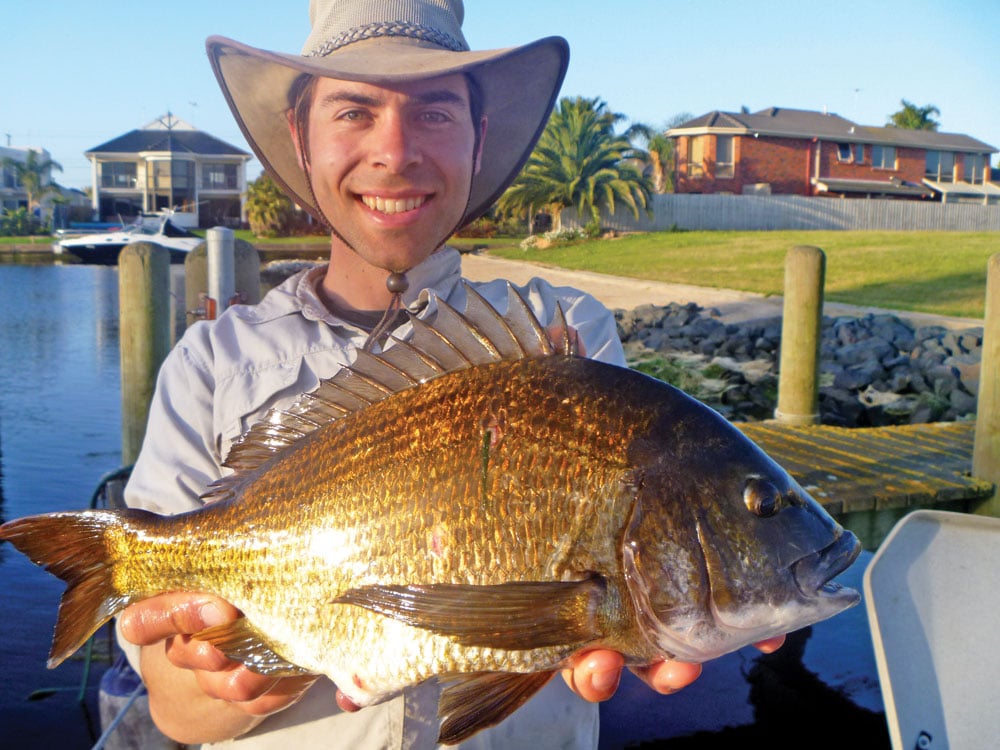
Patterson Lakes, a small outer suburb of Melbourne is just brimming with bream. Richard Linossi explains in detail just how to maximise your catch.
Before Patterson Lakes existed, a large swamp covered the land. Fed by water flowing down from the Dandenong Ranges it covered some 5000 hectares that stretched between Mordialloc and Frankston. This wetland ecosystem known as Carrum Carrum Swamp was drained in 1879 when a 10m wide trench was cut into the earth. This channel, known as ‘Patterson Cut’, directed the water out into Port Phillip Bay and was the early beginnings of the Patterson Lakes that we see today.
From a bream fisherman’s perspective, Patterson Lakes has an almost unlimited potential, consisting of a maze of canals harbouring floating pontoons, moored boats, rock walls, bridge pylons, tiny sandy beaches, muddy banks and weed beds. Most importantly however the system is full of big black bream!
Patterson Lakes is where I first learnt to fish for bream. I remember the first time that I floated into the canal system on my little kayak, armed with some rather crude fishing gear and a hand full of lures. I was amazed at how many bream I could see just ‘hanging out’ under the boats. I spent half the day casting and casting at them but didn’t get so much as a sniff.
Around lunchtime I came across an old man who was sitting in a deck chair in front of his house on a small sandy beach. He was sitting there laughing at me, I paddled over to him and we began talking. He was a local who had lived there for over twenty years, he was laughing at me because he knew that I wasn’t going to catch any of his bream. We spoke for some time, and in regards to fishing this is what he had said to me.
‘Those bream, the big ones, they are smart! They live under the jetty here but as soon as you take your first step onto the jetty they know that you are there. You can give them the freshest baits, but they just know. You can still see them but when they know that you are there, they won’t take your bait, it’s a waste of time.’
At that stage I had only been fishing with lures for other species such as pinkies, flathead and salmon. To me the world of lure fishing was expanding rapidly and the idea of tricking a fish into eating a small piece of plastic or metal was very exciting. I was told that bream were amongst the hardest fish to catch on lures and the words of the old man had just wet my appetite.
I paddled back to the boats and just sat there in my little kayak and watched the bream. As I watched them I could almost hear the fish laughing at me, and at that point in time a saying that my grandpa often used popped into my mind, ‘ahh, but man must be smarter than beast’. I knew that other people had caught plenty of these fish on lures before and it was then that I decided that I wanted to learn the secret of how to catch them too.
I have learnt a lot since then and have realised that bream, just like all other species of fish, are creatures of habit. Once you figure out what they want, they are not so hard to catch. Hopefully the tips, techniques and locations described in this article will help you to find and catch a few more fish.
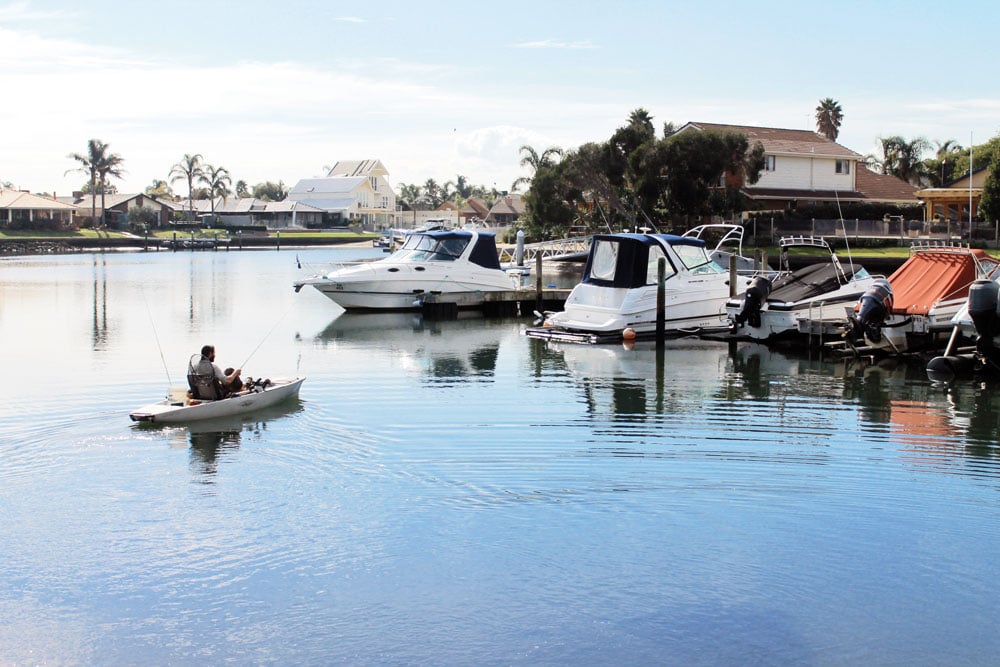
Casting hard bodies at boat hulls in Patterson Lakes is a good option especially when you can see bait fish in the area.
Knowing your enemy
Understanding bream and how they work, how they react to different conditions and what they feed on in a particular locations is vital information when it comes to catching them consistently. I have spent a lot of time observing the bream that live at Patterson Lakes, watching them mill around different structures, watching them as the tide changes and they start to file out from underneath the floating pontoons on their way to patrol the rock walls and weed beds. Watching the flash of their big silver bodies in the fading evening light as they turn on their sides to munch on the barnacles that grow on the pylons and pontoons. Locating big schools of feeding bream on my depth sounder as they prepare to breed. I could fill this entire magazine simply describing their habits and movements defined by the tides and the environmental conditions that change throughout the year. Despite all of this there is only one thing that you need to know in order to catch these bream, and it stems from the words that the old man had told me when I first ventured into Patterson Lakes.
‘You can still see them but when they know that you are there they won’t take your bait, it’s a waste of time.’
The secret to catching the bream that live at Patterson Lakes is to remain totally undetected! You must move silently from boat to boat, pontoon to pontoon, pylon to pylon, for as soon as the bream are unsure about something or have sensed your presence, then it doesn’t matter how good your cast is, or how enticing your offering, they simply won’t respond to it.
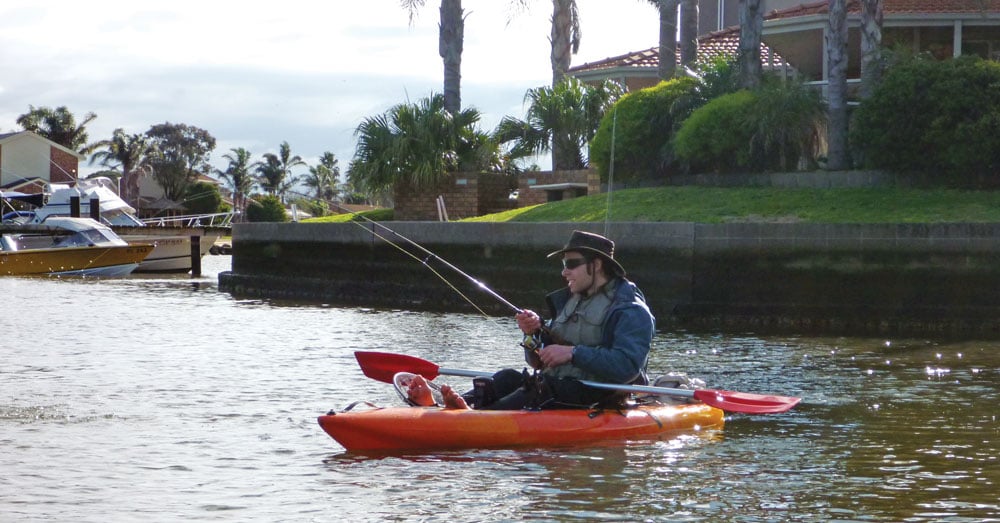
The perfect vessel to achieve this is, of course, a kayak. A kayak allows you to glide silently across the water with stealth as you approach your desired target.
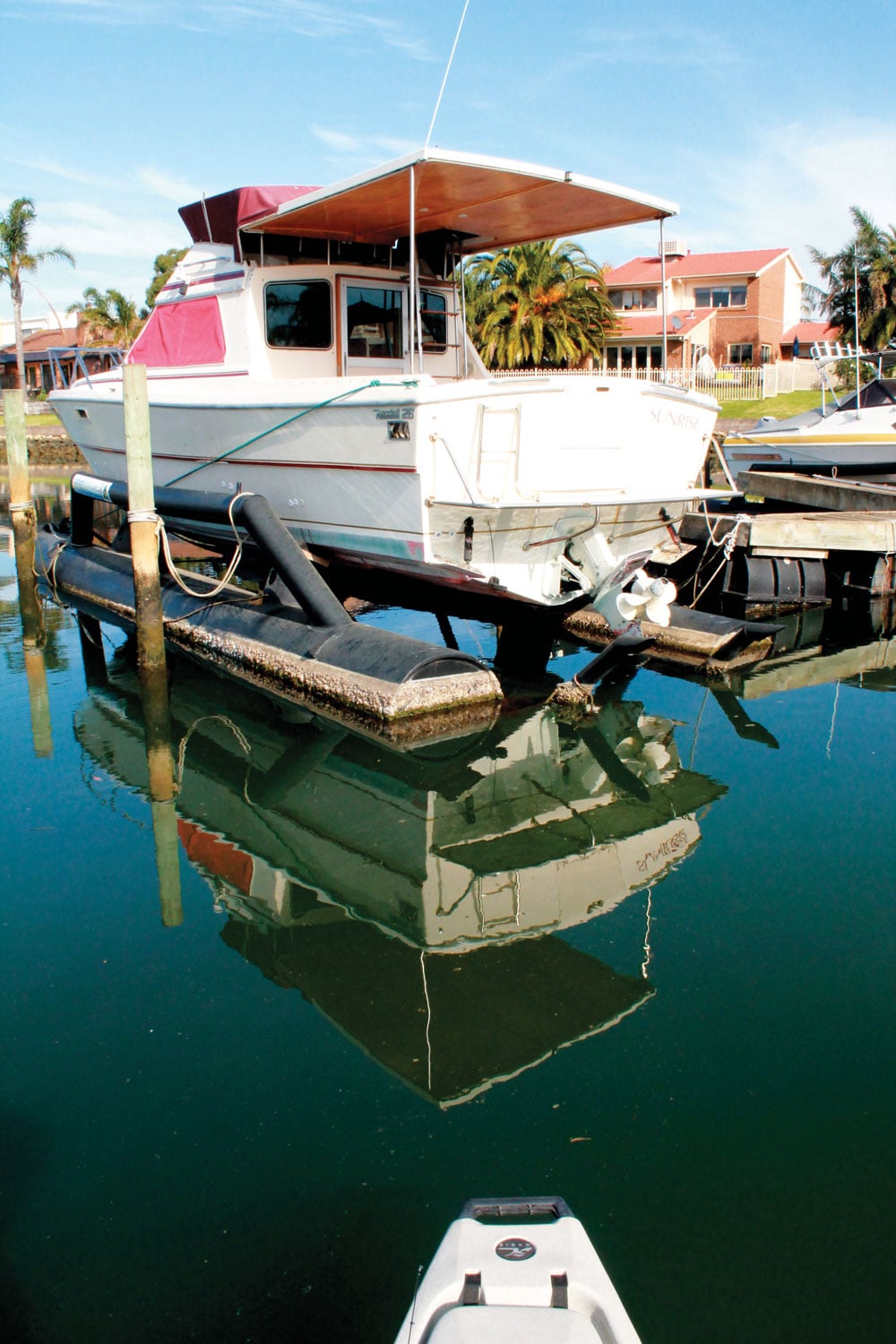
Boat floats such as this are the perfect environments to find big black bream. Fish the shady side of the structure and keep an eye out for schools of bait fish holding in the shade.
First impressions are everything
Ideally you want to place a natural looking lure in front of a bream, without it noticing anything fishy. It sounds simple but there are a few things that you need to master in order to achieve this.
First of all you need to position your kayak so that you are as far away from the structure that you want to fish as possible, but still within casting distance. You need to take into consideration any tidal flow, and any wind that may be present so that you can perform an accurate cast and be in a position to fight and land a fish if you hook one. There is no point putting a lure in front of a hungry bream if it can easily duck back under cover and bust you off instantly. A very useful item to have on board is a small paddle that you can have at hand, something like an old table tennis racket is ideal. This will allow you to make small adjustments so that you can maintain your position and still work your lure.
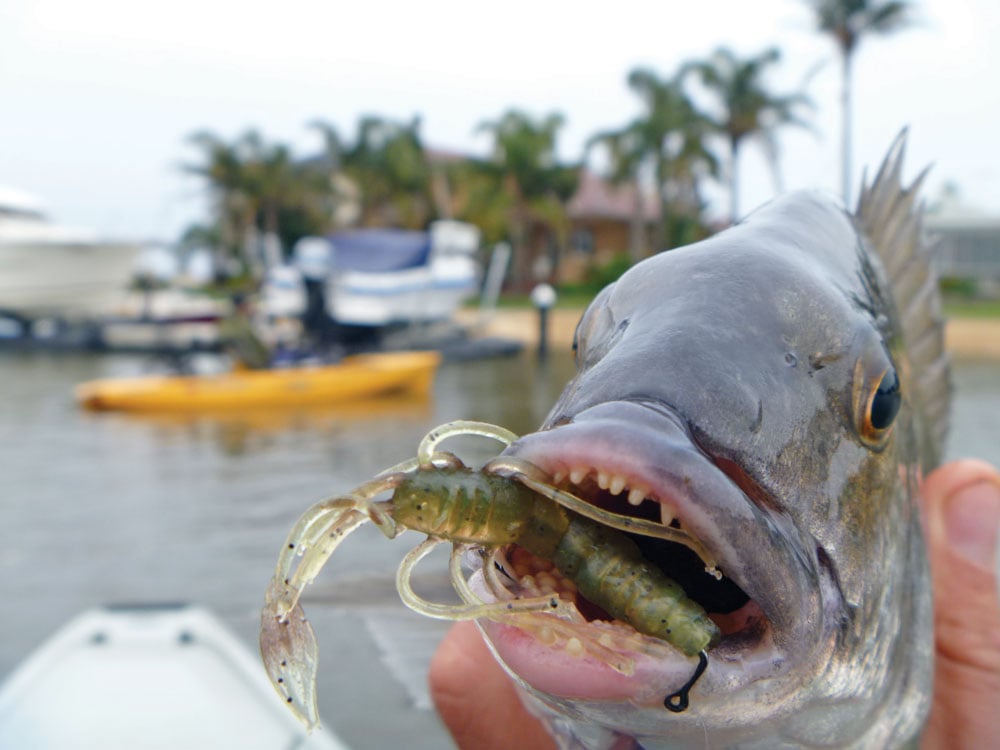
Secondly, the lure that you present to the bream needs to be flawless, if it twists or spirals in an unnatural fashion then the bream simply won’t be fooled by it. Pay extra attention when threading your soft plastics onto your jig heads to ensure that they are rigged straight. Swim the lure in the water next to your kayak to make sure that it looks natural as it sinks and when you draw it through the water. These bream see a lot of lures and aren’t easily fooled, so if something isn’t right then you really are wasting your time.
Finally you need to be able to perform an accurate cast, this may be along the length of a floating pontoon, or even deep into the shadow between a moored boat and its mooring. If your cast lands too far away from the structure then it will likely be outside the comfort zone of the fish and they won’t venture out to investigate it. If your casts lands in a boat or gets tangled up in some old rope you may spook the fish and could also lose your lure, which can become a very expensive exercise indeed.
Remember, if you have to cast two or three times at the same pontoon before you get that perfect cast in, then it is likely that the bream will be onto you and ignore your offering, so you want to get it right first cast.
You are ideally trying to cast a very light lure and have it land within a very small area, say the size of a small plate, first time, every time. When I first started out I was using some rather crude gear and although I had a lot of success, I struggled to achieve a consistently accurate cast. Eventually I upgraded to a higher quality and more sensitive rod, and I have to say that with this style of finesse fishing, the higher quality gear really comes into its own. I now use a custom made 6’8’’ 1-3kg carbon graphite rod matched with a 1000-sized spinning reel, spooled with 4lb braid. This set up has made a significant improvement to my casting accuracy and ultimately to the number of fish that I catch.
If you can master the following three components: positioning your kayak, presenting a realistic looking lure and casting accurately; then a bream will have no reason not to consider your offering as its next meal. So if the fish aren’t biting then remember, that in the eyes of a bream, first impressions are everything.
Beautiful spring
Although Patterson Lakes can be fished successfully at any time of the year, spring is perhaps the most exciting time to fish the system. It is the only time of the year when I have consistently found the bream feeding over all of the different structures in the system. During the months from September to November the bream will be forming big schools in the deeper parts of the river in preparation for spawning, they will be feeding heavily in particular conditions along the rock walls, around the bridge pylons, under the pontoons and boats, along the river and over the sandy and muddy banks.
 What to look for and where to cast
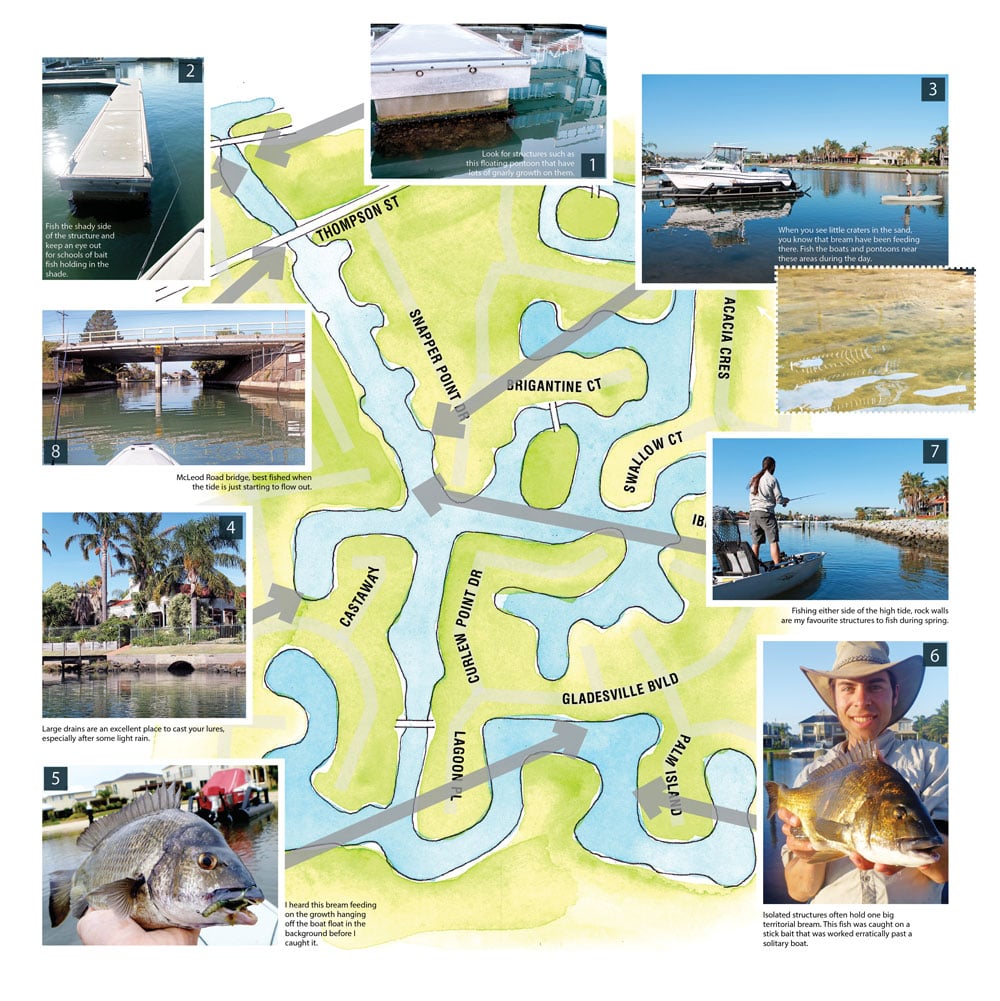
In the Canals
Bream are literally everywhere in the canals, under every boat and pontoon that you can see, and on a clear day you can see them all. It truly is amazing just how many bream there really are in there. However if you want to increase your chances of catching a fish then there are several things that you can lookout for.
1 Try to find old boats, boat floats and pontoons that have been there for a long time and have heaps of gnarly growth on them. These are prime places to target, as the bream there will often be munching on the growth and be in the mood to eat your lure. There are two techniques that I have found to be very effective when fishing these structures. The first technique involves working a small soft plastic, rigged on a 1/40 oz hidden weight jig head, just under the line of growth. This is a good method to try when you can see the bream feeding on the barnacles growing on the underside of the boats and pontoons. The second technique involves casting a slow sinking vibration style lure such as the Strike Pro micro vibe or the River 2 Sea baby vibe as close to the structure as possible. As it sinks through the water column you will often see the bream turn and follow it down. Sometimes the lure will get hit as it is sinking, but more often than not a fish will pick up the lure just as it hits the bottom. I’m not too sure what the fish think this lure is, perhaps a small piece of barnacle that has been dislodged by another feeding bream, or a small crab trying to flee and remain undetected. Whatever they see, this is a very effective technique.
2 On a sunny day you want to target the shady side of the structure. Not only do bream prefer the protection that the shade offers, it is also where you are most likely to locate a school of baitfish that the bream may be feeding on.
3 As you cruise around, it is also a good idea to keep an eye out for any sandy or muddy banks that show signs of prior feeding activity. If a bream has been feeding in such an area then you will often see little craters, about the size of your hand, which a bream leaves behind after digging its nose into the bottom in search for food.
More often than not the bream will feed over these banks during periods of low light, or at the peak of the tide. However, on a sunny day, or when the tide is low you can expect to find the bream sitting under the adjacent pontoons and moored boats.
4 There are several large drains scattered throughout the canal system. They offer a very secure and safe environment for the bream. Perhaps because of this false sense of security, the bream there seem to be more willing to take a lure, especially on days when they are otherwise playing hard to catch. I have found that the best time to fish any of the drains is about half an hour after the high tide when the water is moving through them.
5 Keep an ear out for feeding bream. When a bream is feeding on the growth that is just sitting on the surface of the water you can hear them as they suck on it and break the surface of the water. To get an idea of what you are listening for, purse your lips together and pretend to kiss the air loudly, that is the sound to listen out for. If you hear this noise, usually around any of the boat floats, it means that the bream are feeding on the very surface of the water. Plonking a lure right on top them often freaks them out, and instead I have found that the following two techniques can be used to catch these feeding bream.
Firstly if there is room to do so, cast your lure well past the boat float that you are fishing. Then skip the lure across the surface of the water, working it back towards the boat float, bringing the lure to a halt just before the structure. Now simply let the lure sink in front of the feeding bream, and watch the line for any takes. This technique works really well with both lightly weighted soft plastics and stick baits.
Secondly if you can’t position yourself to do this, or it simply isn’t an option, then there is another trick that requires a little more skill but if you can pull it off the first time then it usually results in a fish. If you are using a lightly weighted soft plastic, cast you lure so that is lands on top of the outer edge of the boat float. The bream will hear this and perhaps be on edge so you need to wait until they return to feeding as normal, usually only about 10-15 seconds. Then simply hop your soft plastic into the water and watch your line for any indication of a bite and hold on tight!
-

- After I had spoken to the old man I returned to Patterson Lakes with a new mindset, one of stealth and accuracy.
-

- Flicking lightly weighted soft plastics at pontoons and boat hulls has caught me more bream than any other technique.
6 If it is a slow day, target floating structures that are isolated from other boats and pontoons. It is likely that there is one big territorial fish there that is holding that ground. If you try a very aggressive retrieve then more often than not the fish will respond.
7 Some of the most productive areas to fish are the rock walls that define the edges of many of the canals in Patterson Lakes. The best time to fish the rock walls is about one and a half hours either side of the high tide. Working deep diving hard bodies, soft plastics or vibes along the line where the rocks meet the sand is a very effective way to get the attention of the fish.
8 The pylons that hold up the McLeod Rd Bridge are covered in mussels that the bream love to feed on. The water here can flow very fast making it very difficult to fish the pylons effectively from a kayak. A small window of opportunity to fish this bridge exists when the tide changes and the water slows to a stop. Allowing stick baits to flutter down beside the pylons, or slowly working hard bodied lures past them is often too tempting for the bream to resist. At first the bite may be slow but as the water slowly starts to flow once more the bream really fire up. You usually have about forty minutes of fishing before the water is moving too fast again.
When it rains
Considering that not that long ago, the Carrum Carrum swamp engulfed the entire suburb of Patterson Lakes and much further afield, the houses and streets there seem pretty high and dry. This is largely because of the highly engineered drainage system that is in place. Consequently when it does rain, a lot of fresh water flows off the land and into the Patterson Lakes system. The water turns to a nice coffee colour and the bream swim deeper to avoid the layer of fresh water sitting on top.
In the canal system of Patterson Lakes the bream can still be found milling around the boats and pontoons, but will mainly feed along the bottom. Casting a 100mm Squidgy wriggler on a 2g jig head and slowly hopping it along the bottom is my preferred way to fish in these conditions.
Interestingly the water in the upper sections of the canal system is less affected by the rain and remains relatively clear. Bream will often congregate there in large numbers and are easily targeted with hard bodied lures.
A light rain creates ideal conditions to fish the drains that are scattered through out the canals. The bream will sit several meters behind the drain, picking off any bits of food that pass them in the faster flowing water. Casting at the drain and allowing a small soft plastic to ‘go with the flow’ can be a very effective technique in this situation.
 In the river
Patterson River holds some excellent fish and it is during spring and summer when it really comes to life. There are several areas along the river that are all worth investigating at different times. In general the river is best fished when the water is clear enough so that you can see the patches of weed that line its banks. Ideally you want to fish it during a high tide, when the fish will be feeding over the weed beds, especially when this coincides with dawn or dusk. Casting hard body lures and twitching them around the edges of these weed beds is a deadly technique. During the heat of the day the bream will often move into the middle of the river where it is deeper. Here you can target them using soft plastics and vibes fished along the bottom.
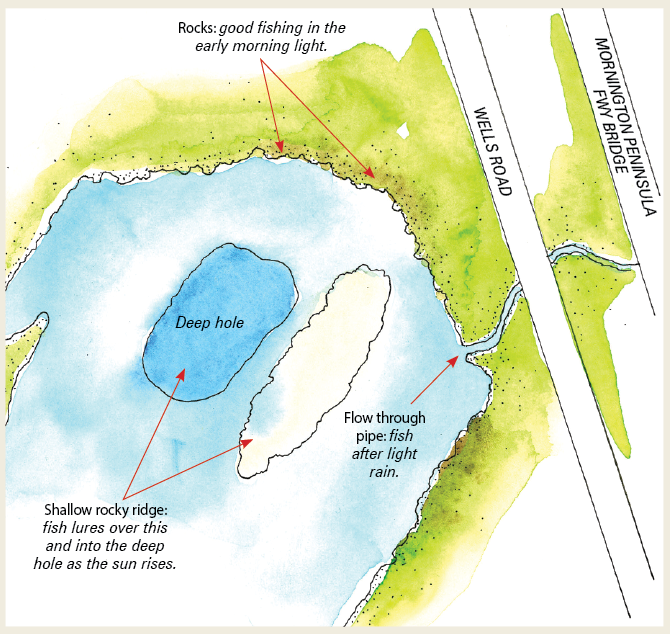
At the far end of the river you will find the Mornington Peninsula Freeway Bridge that separates the National Water Sports Centre and Patterson River. This area is very interesting, consisting of a deep hole surrounded by shallow rocky ridges, a flow through pipe and the outer perimeter is lined with rocks. Early morning is my favourite time to fish this area and you will often see the backs of big black bream sticking out of the water as they push up into the shallows around the rocks to feed. Working hard bodied lures around the rocks usually sees their demise.
As the sun rises and the fish start to move into deeper water, working your lures over the rocky ridges and into the deep hole is the way to go. This is also an excellent place to try after it has rained as the flow through pipe will be pumping and bream will often sit near the edges of the flowing water, waiting for a meal to pass them. However, after prolonged or very heavy rain, the water from the National Water Sports Centre can flow over and flood into the Patterson River. In these conditions you are often better off fishing at the entrance to the river.
Working towards the entrance it is always worth fishing the areas directly in front of the three floodgates that lead into the canals and the marina. The water there is deeper and this is where you will often find big schools of bream in late September and October. Although you may sound schools of fish in these areas at any time of the tide, it can be hard work getting them to bite. I have found that the best time to fish for them is just after the high tide, when the water starts to flow out from the canals and marina. Casting vibes past the fish and working them through the school seems to be more effective than casting directly into them. If you can’t feel your lure vibrating as soon as you lift it off the bottom, then you should increase the weight of your vibe. You want the lure to hold on the bottom when paused instead of dragging along the bottom in the current.
Now onto my favourite spot to fish: the entrance to the Patterson River itself. At the entrance you will find the Nepean Highway and Railroad Bridge. This is a sure spot to find a lot of bream after heavy rain. Bream will tend to school up around the pylons, especially on the incoming tide when fresh seawater is surging in. If you are lucky enough to have a high tide coincide with first light after some heavy rain, then you are sure to be in for a good session! Some of my best catches have come from slowly rolling hard bodied lures past the big concrete pylons in the centre of the river. Fishing throughout the entire system I usually tie on 3lb fluorocarbon leader. However, after having lost lots of big black bream to the barnacle encrusted pylons at the entrance, I prefer to use 6lb and even 8lb fluorocarbon leader in order to turn the bream and pull them away from the pylons.
No matter what the conditions, there is always a bream somewhere in the Patterson Lakes system that is willing to eat your lure. Now is the best time of year to get in there and explore and catch some of the big black bream that call Patterson Lakes their home.
Fish responsibly
Because of the variable water quality at Patterson Lakes, most fishermen release all of the bream that they catch and just enjoy the thrill of hunting them. However if you are after a feed, then it is always good practice to let the bigger bream swim free, as they provide a significant contribution to the breeding cycle. Either way, it is easy to get caught up in the excitement of catching a bream but one must always remember where they are. In the eyes of the people that live on the waterfront at Patterson Lakes, you are a guest and you have a responsibility to respect the boats and pontoons that surround you. By doing the right thing at all times, by not leaving hooks caught up in ropes, releasing the big bream and simply respecting the place, Patterson Lakes will continue to be an exciting and productive bream fishery in the near and distant future.
Richard grew up fishing and exploring the beautiful surf beaches and rock platforms scattered along Victoria’s coastline. He has been kayak fishing since the age of 21 and has explored almost every estuary system between Nelson and Mallacoota. He makes most of his own lures and enjoys the challenge of tricking even the fussiest of fish into eating them.