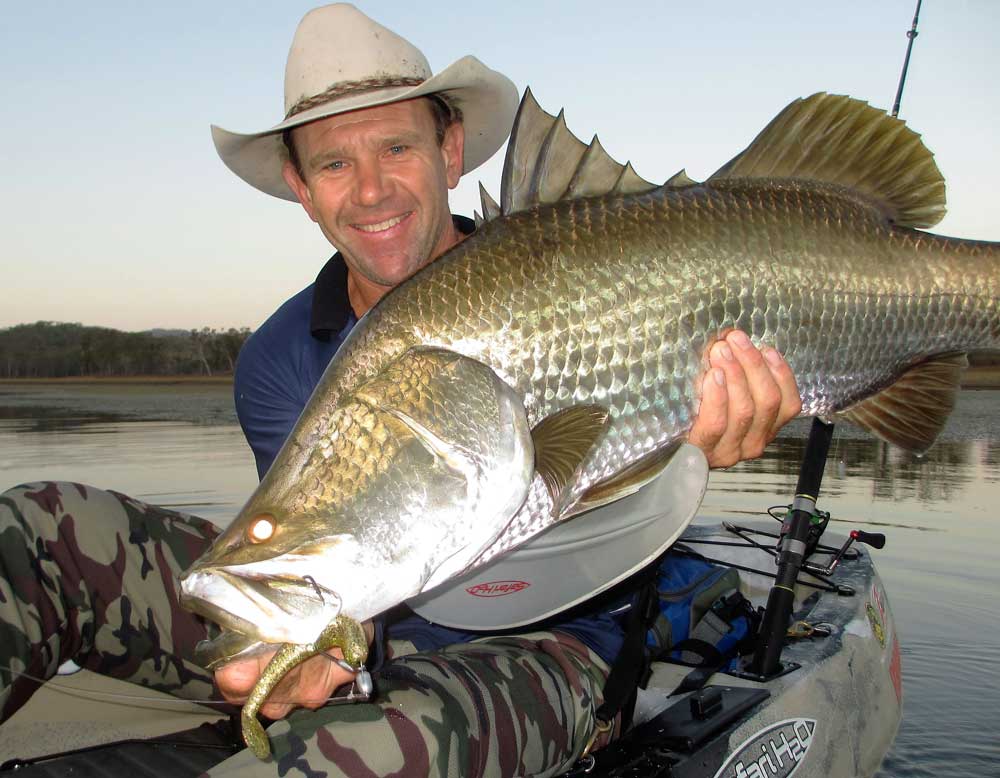
Ever wanted to tick barramundi off your bucket list or aspired to join the one metre club? With the warmer spring weather upon us, now is the prime time to start planning that trip to one of Queensland’s barramundi impoundments. Avid barramundi angler Dave Brace provides several hot tips for you to put your best foot forward to catch that fish of a life time.
As we all well know, barramundi are one of Australia’s most well-known and chased prized sportfish, with their ability to snap fishing line, straighten split rings and hooks, not to mention destroy lures which can leave the angler in total despair and disbelief when it transpires.
It’s no wonder barramundi are the top dog of the food chain in our impoundments. They possess large scaled armoured bodies with extra hardened jaws and boast super sensitive lateral lines which detect minimal vibrations in the water, assisting them in finding their prey and to avoid danger. Barramundi are ambush predators with their eyes positioned on top of their heads meaning baitfish, frogs and lizards have no chance when they are in a close proximity.
These unbelievable hunting attributes of the barramundi can sometimes be a disadvantage to these fish, as the hunter now becomes hunted, by tuned in anglers.
Beneath the water barramundi use various structures such as fallen horizontal timber, rocky ledges and thick stand up timber to ping line on in the hope to regain their freedom once hooked. Above the water, their spectacular aerobatic skills are a breath-taking spectacle. These fish have a tendency to emerge from the depths and launch themselves to great heights while violently shaking their head in an attempt to dislodge the lure they’ve just engulfed and the ability to do so probably explains why so many anglers get hooked on targeting them.
TIP #1 – PLANNING AND RESEARCHING
Many anglers fail to plan and research when organising a trip to Queensland’s premier Barramundi impoundments which inevitably leads to disappointment. Sometimes it’s not all about the destination, so consider planning as part of the journey and enjoy it with mates.
Studying a fish’s traits, likely holding locations and structures they prefer to ambush their prey from as well as their feeding moods and spawning rituals should all be analysed.
Barramundi can easily be found within a short paddle from launching areas on these larger lakes during particular times of the year, it’s just a matter of knowing how, when and where. During the spawning season barramundi move downstream of the dammed rivers to seek brackish water in which they can do their business. When they finally reach the man made structure of the dam wall, they tend to congregate within that area for the large rain events of late spring and early summer. They wait for water levels to eventually rise and in order to push them further downstream.
Whether you live in far north Queensland, south of the state’s border or west of an outback town, it can be extremely advantageous to travel that extra three to five hours to a particular lake in search of these fish rather than just stopping at the closest lake. This is dependent on the weather conditions leading up to your departure. It could be the difference between catching one or two fish or large quantities.
Sometimes a plan ‘B’ is a great option to have up your sleeve in case plan ‘A’ becomes pear shaped due to freak weather events. One thing that I have learnt over the years when fishing these land locked environments is that no two days are ever the same.
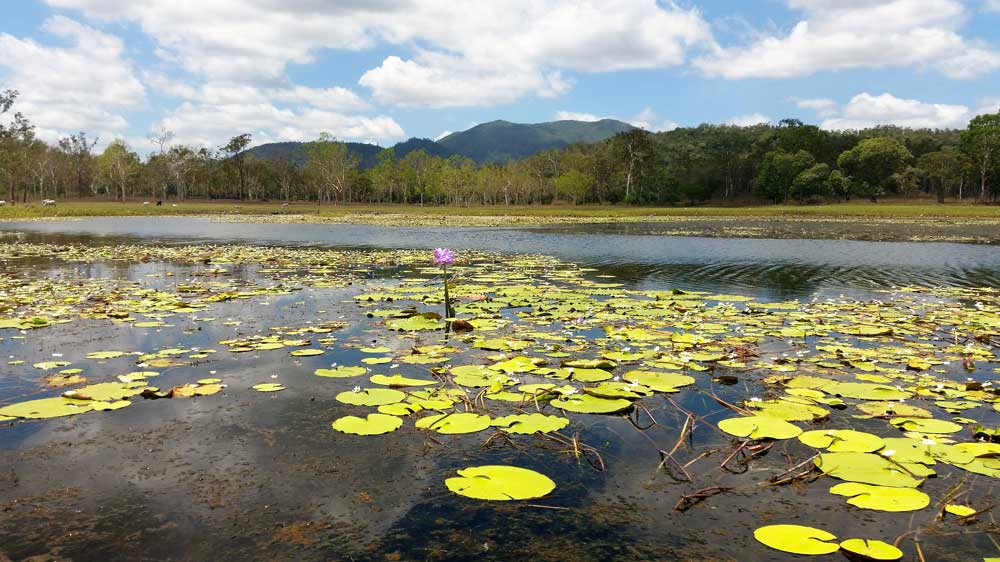
Premier barramundi country for trolling soft plastics along the lily edges and weed hedges just beneath the surface.
TIP #2 – ROD, REELS AND LURE SELECTION
The outfit I prefer to use is a Silstar 6’6” Crystal Power Tip rod matched with Okuma’s RTX Pro 40 spin reels spooled with 30 lb Platypus Platinum Plus braid and a short length of 60 lb Platypus Game leader.
The lures I have most confidence in are Z-Man’s 6” and 4” SwimmerZ in red shad, houdini, pearl and smoky shad which represent the profile of bony bream which are prevalent throughout Queensland’s Barra impoundments. More subtle soft plastic lures such as Z-Man’s range of 5” and 9” GrubZ are also worthy of packing in a tackle tray. These soft plastic lures are made from 10x Tough Elaztech which means they can take their fair share of abuse before they require changing. Rigged weedless on the award winning TT Lures SnakelockZ in an 8/0 hook and ¼ oz head is perfect for shallow water presentations or if trolling in open water.
If the barramundi begin to short strike your lures when trolling open water, attach a stinger hook configuration and scent up using something like Pro-Cures Super Gel bait scents. As for hardbodies, lures such as Storms Thunder Barra, Twitch Sticks and Rapala’s range of XXX-Raps are all up to the challenge of attracting these hard hitting fish and already retro fitted with X Strong VMC hooks as standard.
Catching smaller barramaundi with a graphite rod is achievable from a kayak; however when you start catching fish in excess of a metre, subduing these destructive fish with these particular rods can be tough. Rods made from graphite can find themselves bent over beyond their limitations and at very acute angles beneath the kayak where you have less control. As a result I only recommend using a fibreglass composite rod for targeting larger fish. Finding a rod with a long butt is also strategically advantageous as it gives you more leverage when fighting these larger belligerent fish.
TIP #3 – KNOTS MADE SIMPLE
When it comes to selecting the right knots to tie, keep it simple. Get familiar with tying effective knots that work for you, that are easy to tie and are quick to configure. Don’t get complacent and adopt a ‘she’ll be right’ attitude as fish will find the weak link when hooked up. Re-tie knots daily and be vigilant when checking their state during each session. Pay particular attention to the chafing of the leader after each strike or capture.
Eliminate every weak link possible; even avoiding the use of clips is favourable. If for whatever reason one was used I recommend the centauri knot for tying terminal tackle. I also like to use the improved albright knot for attaching the leader to the main line and a loop knot to all lures to allow for maximum manoeuvrability.
TIP #4 – STOP, LOOK AND LISTEN
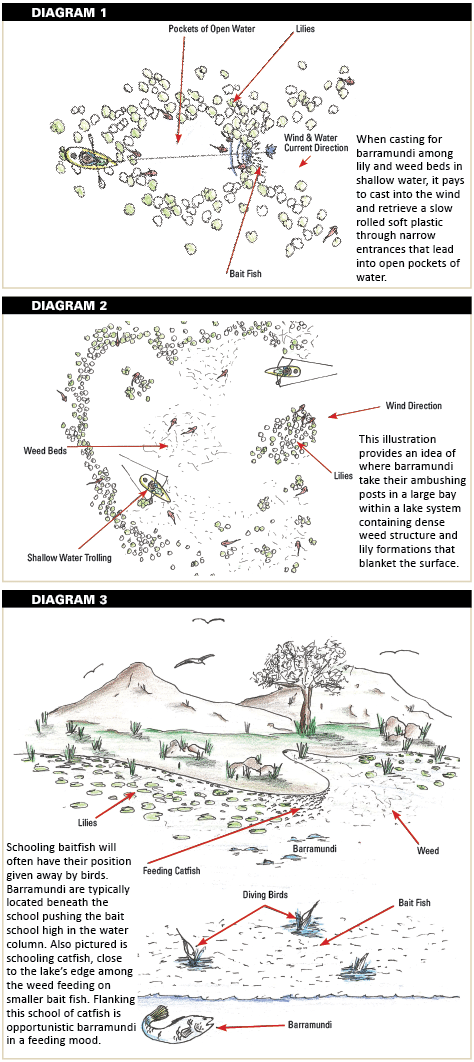
Failing to put down the fishing rods to look, listen observe and be one with nature brings about the demise of many anglers wanting to experience impoundment barra. Acting on the theory of the three ‘B’s’: if you find birds working the surface it is extremely likely that they are targeting baitfish in the upper water column, these baitfish are usually pushed higher in the water for a reason and that could be due to predatory barramundi in feeding mode.
Take note of where you locate these baitfish during the day so that you can target the area under the darkness of night. These schools tend not to move too far depending on weather conditions.
Other signs to keep a look out for are wind direction and changes of weather patterns during the day. Look for tailing barramundi on the surface sunning themselves in a digestive mode among the shallows. They might not be interested in feeding at the time, but you know of their whereabouts for later on. If you see a fish in this mode, it is also very likely that there will be more fish within its vicinity which may not have fed already, so work the area hard and methodically.
Listen for schools of catfish working closely to weed edges where they take advantage of small baitfish. Once found in a feeding frenzy, select a lure that matches the hatch and either cast or troll it adjacent to the catfish. Barramundi will likely be in an ambush mode cleaning up fleeing baitfish and targeting stray catfish wandering too far from their school.
 TIP #5 – TARGETING FISH STRUCTURE
Fish structure can be found everywhere, often unseen by the naked eye. It could be as simple as a current line in deep water, however more stand out structure includes rocky outcropped points, weed and lily beds and timber. Hooking up in heavily timbered areas can be a terrifying experience for the novice angler and I would advocate fishing areas less intimidating such as weed beds, which for my mind is probably some of the best structure to find fish. If you were to however hook up to a big fish in a labyrinth of timber, it is best to fight the fish on a very short lead and not allow it to take long runs. A tip to prevent this from happening is to take the pressure off the fish by opening up the bail arm of your spin reel when you feel you have lost control. By doing this, the fish will stop fighting which gives you the opportunity to place the bail arm back over and retrieve line back on the spool while paddling and winding in and out of the stand-up timber. Once you have caught up to the fish, load the tension back on the rod and proceed to fight and wear the fish down again.
Targeting barramundi within weedy and lily laden areas adjacent to deeper water is a preference which offers so many more opportunities. The weedy structure can vary immensely offering a multitude of ambush points for the fish. This type of structure also suppresses the heat of the water with the lilies forming a blanket that repels the heat.
Fishing weedless presentations with a squid skirt over the knot, to avoid the collection of weeds with any protruding line, is a good option.
TIP-#6 – TROLLING TECHNIQUES
Trolling for barramundi is the most effective technique when targeting these fish from a kayak. While I prefer to feel the thumping strike from a barra when cast and retrieving, the results speak for themselves regarding the catch rates between casting and trolling when targeting this species.
There are three factors that you’ll need to consider when trolling. The length of the line you have out the back of your kayak, the speed at which you are trolling and the fishing rod’s angle or height of the rod. Position your rod tip high, as it will set the hook once the fish strikes. Having your lure set far behind your kayak holds some merit but due to the stealthy nature of kayak fishing it is somewhat unnecessary.
When trolling, lures are kept within the fish’s strikezone for longer periods and the more time the lure is kept within the fish’s strike range, the more opportunity the lure will get hit by an opportunistic fish. The theory of fish being aroused by other fish actively feeding is one I believe in wholeheartedly. As a result, when this chain reaction occurs, with every pass while trolling, it is common to attract numerous fish with double hook ups and chaos on the water. It’s what we as anglers only dream about. Upon a fish striking the lure when trolling, refrain from grabbing the rod immediately; rather take three really strong strokes of the paddle to set the hook. Having a light but firmly weighted reel drag setting is paramount and will make removing the rod from the position of the rod holder so much easier.
I strongly recommend heading into the dense weed that rises to the surface. For anglers with kayaks equipped with pedals, use a paddle instead as you are missing out by not getting into the strikezone when targeting barra among this structure. With every stroke of the paddle a slight variance of speed is evident which assists the action of the soft plastic lure.
Depending on how shallow the lure is trolled behind the kayak, the lure will effectively be caught within the vortex of this swirling water from the paddle. This allows the lure to swim rather erratically which predators identify as a baitfish under duress. Allow the lure to rise and skim across these weed beds and subsequently allow it to drop within the surrounding pockets of more open water by reducing your trolling speed.
TIP #7 – OPTIMISING FISHING TIME
It may take a day or two on the water to work out when, how and where the fish are feeding; however, if you have planned your trip correctly, this time could be minimised. Dusk and dawn are always great times to target barramundi; however low light periods can be even more productive when they coincide with moonset and moonrise times. Coincidently, these times also align with tide changes within the salty reaches downstream of the lakes. This occurs around the days surrounding full and new moon phases.
During spring and leading into summer, the heat of the days can be intense so fishing at night is favourable. It is under the darkness of night that larger fish can be caught consistently and at times they can be found away from structure. An incredible time to target these fish is approximately one hour before moonset between the later hours of the night and in the very early hours of the morning surrounding the full moon phase. If you have chosen the right area to fish during this time and the fish are in a feeding mood, it can be nothing short of pandemonium.
Even though fishing at night during a full moon phase makes it easier for the angler to see, fishing at night during new moon phases is equally effective. Being darker with minimal moon light present sees barramundi feed higher within the water column, making them easier to target and less easily spooked. If you spot baitfish near the surface at night, it pays to troll around the area, particularly if they are flighty under the light of your headlamp. If they start to erupt, jump and scatter, it is a tell-tale that hunting barramundi are within the vicinity.
BRING YOUR ‘A’ GAME
Targeting these majestic fish from a kayak is nothing short of breath-taking and extraordinary. The fundamentals in unlocking the secrets of these fish are only achieved after spending copious amounts of time on the water, being astute, persistent and extremely vigilant.
Working out when these fish are inclined to be in a feeding mode is much harder than it seems in reality with the wind being the largest environmental influence to trigger bite periods, whether you are fishing deeper water or the shallows among the weed.
If you are inclined to venture to these Queensland impoundments to tussle with these iconic Australian sport fish, be sure to bring your ‘A’ game.
David has been passionate about fishing since his youth and in the past five years has been contributing in an honorary capacity to Queensland’s freshwater fisheries. He has been a member of MASA for a number of years and was involved in restocking barramundi into Lake Monduran. Now he is the founding president of the Ewen Maddock Fish Management Inc. a fish stocking group within the Sunshine Coast Hinterland. David primarily fishes freshwater and enjoys targeting Australian bass, saratoga, Murray cod and his favourite, barramundi. He prefers to target fish from his kayak.