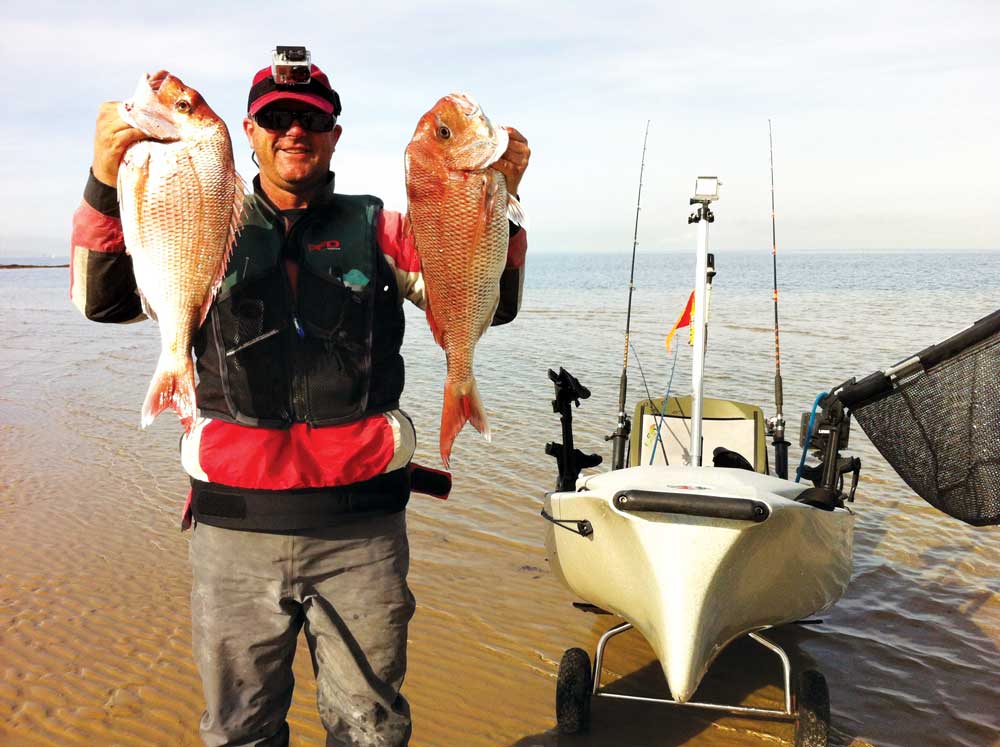
With another Melbourne snapper season in full swing, it’s an ideal time to revisit kayak fishing safety; after all, it’d be a shame to hook a giant red bumpy feller only to not return to enjoy a big bad brag. Where’s the fun in ending up in Davey Jones’s locker? Robbie Waller shares some life saving tips to keep you safe this spring and beyond.
To help Yak Fisher out and to ensure we provide you with sound advice, Transport Safety Victoria has kindly handed over 13 kayak angling safety reminders.
How do you measure up on the following?
1. Practise re-entering your kayak in shallow water
Many people have not developed this skill prior to heading out into deeper water where it becomes much more difficult. The best way to get back in is to float your legs out behind you, upwind of the kayak, and slide on while keeping a low centre of gravity. There are many videos on YouTube that demonstrate effective techniques.
Equipment such as paddle floats and stirrups will make re-entering easier for those struggling with stability of the kayak or lacking upper body strength.
2. Tell people where you are going and what time you intend to return
If someone on shore knows you are overdue, they can raise the alarm when you might not be able to. Don’t forget to tell them when you have returned so they don’t set off an unnecessary search.
3. Carry communications equipment
If your mobile phone is in a waterproof pouch, you may still be able to make calls to raise the alarm. A personal locator beacon provides you with a robust mechanism to raise the alarm. It would also be useful if you enjoy other outdoor activities that could see you in need of rescue.
4. Be visible
A high visibility vest or flag will reduce your chances of being run over by another vessel.
Lights are important at night or in fog. You should have either an all-round white light or a torch that can be used when you need to be seen.
5. Check the forecast
Before you set off, have a good idea what the weather is going to do throughout the time that you intend to be on the water. Use a reputable source to get current information and remember to check for updates.
Be alert to the signs of changes in the weather and know where the closest sheltered water is.
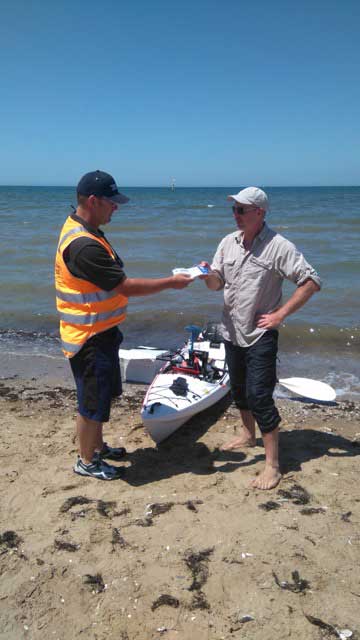
Transport Safety Victoria are helping educate kayak anglers
6. Stay attached
Use a paddle leash to tie the paddle to your kayak, or a leg leash to attach yourself to your kayak. But be aware of entanglement issues, especially when casting lines and adjusting rods.
7. Wear the right lifejacket
Ensure your lifejacket meets the appropriate standards. Bright coloured lifejackets will assist you to be seen and newer lifejackets will keep you afloat more effectively. If you fall out, re-entering your kayak will be harder if you are wearing a type 100 or 150 lifejacket.
8. Dress appropriately for entering the water
It is easier to cool yourself down than to warm yourself up. Wind and waves will make you colder than you anticipate. Weather changes in Victoria can be sudden and extreme so be prepared.
9. Take lessons from an expert
Training providers can teach you effective strokes, self-rescue techniques, how to read the weather and how to dress for the conditions.
10. Cold water immersion
Cold shock is the body’s response to suddenly hitting cold water and it occurs when water temperatures are less than 15 degrees. It starts with an involuntary gasp, uncontrolled breathing and increases in blood pressure and heart rate. Be aware of the 1:10:1 rule. You have one minute to control your breathing, 10 minutes of dexterity to arrange your rescue, and one hour before hypothermia sets in.
11. Be aware of your capabilities
A headwind will reduce your ability to make way. An offshore breeze may look enticing, but waves will increase relatively close to shore and it will be much harder to return to the protected areas near land. While the paddle out might be easy, make sure you have the strength and energy for the return trip.
12. Paddle in a group
There’s safety in numbers. If you’re in trouble your companions can keep you calm, stabilise your kayak, give you a lift/push and raise the alarm.
13. Carry a means of removing water
If you can drain water from enclosed spaces you may save your kayak from sinking, or becoming too heavy to paddle. This requires you to have some means of removing water that collects in areas that do not drain overboard.
There are hand pumps available that are designed specifically for this purpose. Or you can use a sponge or bailer to remove nuisance water. When using hatches for the storage of equipment, be very careful not to allow large volumes of water to enter the space.
CASE IN POINT
Darren “Rhino” Ryan is not only a ‘sock it to ’em’ kayak fishing snapper specialist, he’s also been involved in six kayak rescues. That puts him in the David Hasselhoff class of kayak fishing gentry. He knows a thing or two about how things can go wrong.
“Of all the kayak rescues I’ve been involved in, there have been a couple of common denominators. First, for one reason or another, the guys couldn’t get back on. In some cases they didn’t have kayak re-entry skills and had become fatigued. In other cases kayak hatches had been left open prior to capsize, and the water ingress made them too unstable to remount. Water sloshing about inside a hull is known as the free surface effect, and it’ll cause major problems even for the most experienced of kayakers. The second common denominator was that no one had carried a bailer or pump to bail the water out from inside their hull,” Darren says.
“That shows kayak fishing safety is about the decision making and planning you undergo even before you get to the water. It’s also about the decisions you make through a paddle session.
“For example, I was involved in the rescue of a father and his four year old son at Altona. In that case the water near the shore looked calm and glassy, but the offshore wind was blowing hard further out, chopping it up. The four year old was riding in an open front hatch of a sea kayak, and they’d capsized. Given the front hatch was open; the kayak had taken on water which couldn’t be bailed due to the lack of a bilge pump.
The father managed to get his son back on, but couldn’t remount himself and he was becoming fatigued. While I saw the trouble they were in from back on the beach, to the untrained eye it just looked like a bit of splashing about. Other beach goers had no idea what was unfolding. I changed my plan of swimming out to them and raced to the boat ramp where I borrowed a guy’s jet ski. Another jet ski followed me out. By the time we got to their kayak, they were difficult to find as they’d be blown another 300 to 400 m offshore.
They both survived, but the young bloke had entered early stages of hypothermia and they needed hospitalisation. It really could have been a disaster,” Darren said.
Darren’s rescue highlights how things do go wrong quickly, and can then go from bad to worse without proper planning, skill sets, safety equipment and/or decision making.
Robbie was born and raised on Victoria’s West Coast where old style wooden barracouta later turned crayfish boats were plucked up onto piers after each journey. He’s been an enthusiastic kayak angler for over 10 years, and Robbie gets a big kick from helping define the techniques and gear that are suited to the evolving sport of kayak fishing.
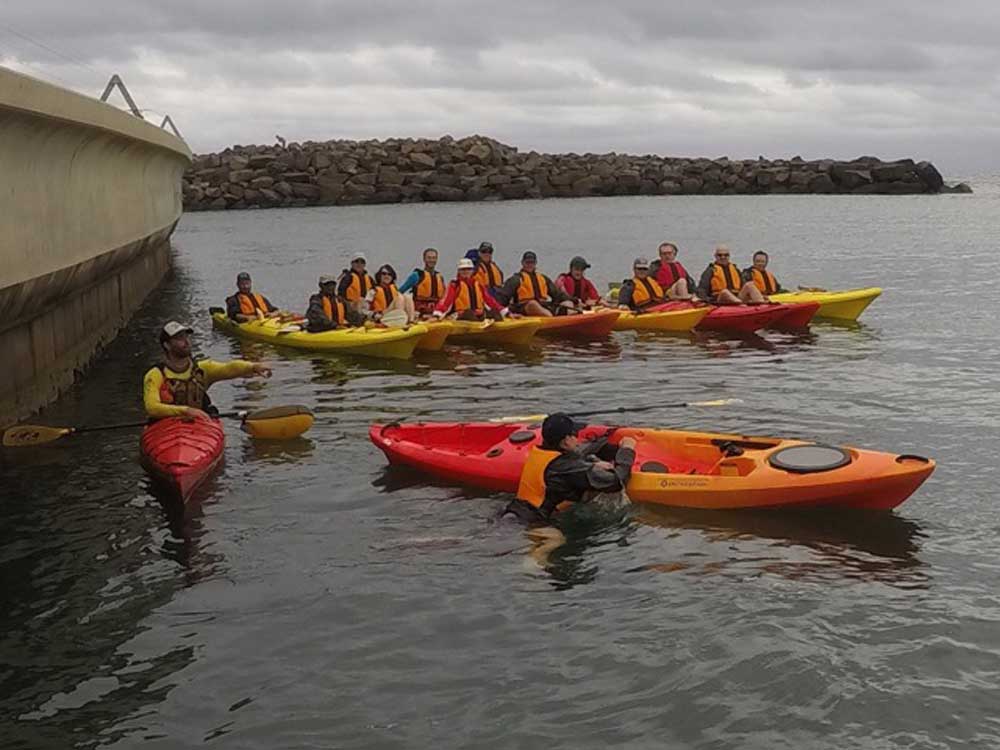
Kayak re-entry practice is essential.