Well-known Barra angler and guide Jason Wilhelm details some of his favourite ‘reaction bite’ methods for targeting salt and freshwater barra.
Barramundi are an extremely popular sportfish that many anglers spend a lot of time trying to catch. For this reason they attract a lot of media coverage and much of this information centres around the ‘slow as you can go’ approach. While this can be the case some of the time, it is quite often the opposite and many anglers make a fundamental error by persisting with slow retrieves all of the time. There are many different ways barramundi can be targeted, variations in lures, retrieve speed and cadence as well as a mountain of techniques that can be learned and mastered. The challenge lies in discovering which technique will produce the bites on any given day. Throw in a curve ball like targeting big fish and all of a sudden a whole range of other considerations need to be factored in.
Discoveries in barra fishing and exciting ways to catch them are there for those who seek answers. If you have a rule book for barramundi, do yourself a favour and throw it out because we don’t make the rules; the fish do! Some of my most successful patterns are quite the opposite of what’s considered standard barra practise. One of the most valuable lessons I have learnt in the past few years is the effectiveness of fast retrieves. There will be extended periods in the calendar year where slow retrieves will see very few fish landed, yet a slight change like retrieve speed could have had fish climbing all over your lure on almost every cast. Can it be that profound? Absolutely! If you want to catch more fish using faster style techniques then it is well worth looking at why these retrieves work, and some of the thinking and equipment required to be a fast lane barra angler.
I’d like to share some techniques that work very well on salt and freshwater barra; don’t be fooled by thinking they are not the same fish. Regardless of where they live, these fish are both instinctive and highly aggressive predatory feeders. Quite the opposite of a mangrove jack, that will protect their patch through thick and thin, the nomadic barramundi will travel the tides and currents continually seeking locations that complement their arsenal of predatory skills.
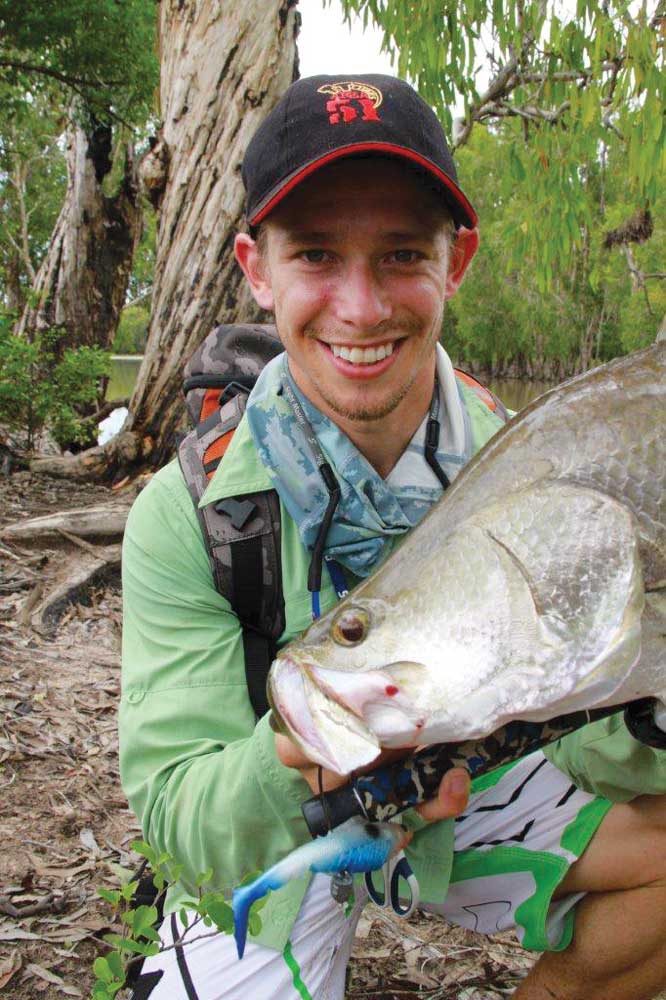
Fast retrieves can really set your session alight. The world champ doesn’t need to be reminded how important speed is…
Background – A New Discovery
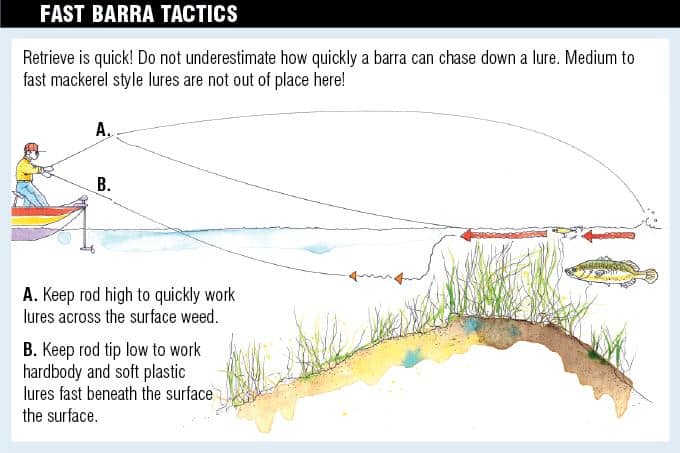
My first ever discovery on ultra-fast retrieve barra was in 2004. I was fishing a sunken weed bed on the eastern shoreline at Lake Awoonga. The shoreline weed was about half a metre deep and it ran at this depth for eight to ten metres before dropping into a deeper three metre sunken weed edge. I was focussed on casting to the deeper weed and mistakenly put in a cast that went too far and ended up in the shallows. My soft plastic lure was quickly burned over the top of the weed so it didn’t get fouled; the plan was to pause it over the three metre section. It never made it. The result was a bone jarring bite and 112 cm of barramundi in the net. The next few hours proved it was no fluke.
That eye-opening experience became a catalyst to seek out more; the research became a big part of my every day fishing habits on the dams and in the salt where the technique developed and evolved. I vividly remember this phase of my on-water experience because it had gone against the grain of everything I read and thought I knew about barra. Someone forgot to tell the fish that they like it fast too!
Why Speed Works
One of the real beauties of speed fishing is that you can actually force fish into eating your lures. Fish are not always actively feeding and if your employed technique involves a slow retrieve there could be many hours without a bite.
A fast retrieve encourages a fish to eat a lure more out of pure instinct and stimulation than hunger. In essence, the fast retrieve uses a different catalyst to promote a bite. This approach also forces fish to make a quick decision: if they don’t eat it, it’s gone in a millisecond. In a similar fashion, a cat will often attack a mouse to destroy it rather than eat it. This instinctive behaviour typifies traits shared by many species in the animal world.
“One of the real beauties of speed fishing is that you can actually force fish into eating your lures”
When Fast is Best
The faster style of retrieve provides an addictive type of fishing and as such I often start off by using this technique. I only switch to slower style retrieves if I have not had a response after a pre-determined amount of time has passed. Generally, you will get an indication of sorts quite quickly when burning plastics or hardbody lures. It is either going to happen straight up or it won’t on a given day, so don’t spend your whole session burning plastics if you’re not getting any response. In the event that the fish are responding to a fast retrieve by chasing, bumping or boiling at a lure, but not committing to eat it, slow down a fraction until you get the desired result. Conversely, if you’re getting follows to the boat without takes, try speeding up even more!
I have become a big advocate of burning plastics when a fishery is found to be tough for whatever reason. Simply because the water you can cover is unrivalled by any other technique, meaning you’re exposing your lure to far greater numbers of fish than any other retrieve. Often when a reaction bite is on, it will be on for a period of time which can last for up to three or four months.
Once you do crack a pattern when burning lures, watch the numbers roll. I have had huge sessions fishing solo, with mates and on charter at Awoonga and Monduran and even bigger days in the salt. You’ll have boats all around you scratching their heads because they won’t be getting so much as a bump and you’ll be getting triple hook ups. Back at the ramp, you’ll get the same question: “What lures were you guys using?” Same story, it’s always about the lure, never about how it’s driven.
Seasonally speaking, burning lures will be effective during all months of the year, especially during the colder months when the prevailing weather conditions swing the balance of power back to the angler. Fish will congregate in only a handful of water depths and locations, meaning they are less diluted.
Observation is always a critical ingredient when fishing and when using fast retrieves, this is no different. Nature will always let you in on little indicators if you’re aware of your surrounds and willing to absorb them. Do baitfish look relaxed while happily cruising the surface, or are they tightly packed and nervous? Has there been a recent spike in water temperature? What is happening during slight changes in environmental conditions on the day? Keeping your eyes open will help you solve the puzzle a lot faster on any given day.
 Techniques
Commence a session by finding a weeded bank, timbered bay or gradually shallow edge that has water covering it. Cast your lure and just before it hits the surface click your bail arm over and start your fast retrieve. Keep your rod pointed at your lure and maintain rod tip height so that the plastic swims sub-surface without blowing out of the water. Once you get started you will figure out subtle changes to your rod tip and retrieve speed that will make life easier and ultimately help to catch more fish. You will soon settle into a fast rhythm and it will become second nature. When the first fish belts your retrieved lure be sure to hang on because they don’t often miss!
The Right Speed
By now you’re probably asking yourself ‘How fast should I go?’ Let me assure you that there isn’t a reel on the market that will retrieve a lure too fast for barra. Am I talking about a flat stick, tuna style retrieve?, yes I am. I know this goes against the grain of all the ‘experts’ and I am comfortable with this. As already stated, we don’t make the rules, the fish do. With that in mind, it’s up to us to find out what it is that makes barra tick, what triggers them and ultimately the best presentation on the day. If you’re a one trick pony who only has the ‘slow as you can go’ mentality, I might as well warn you here and now that there will be a lot of days where you’ll go home wondering where it all went wrong.
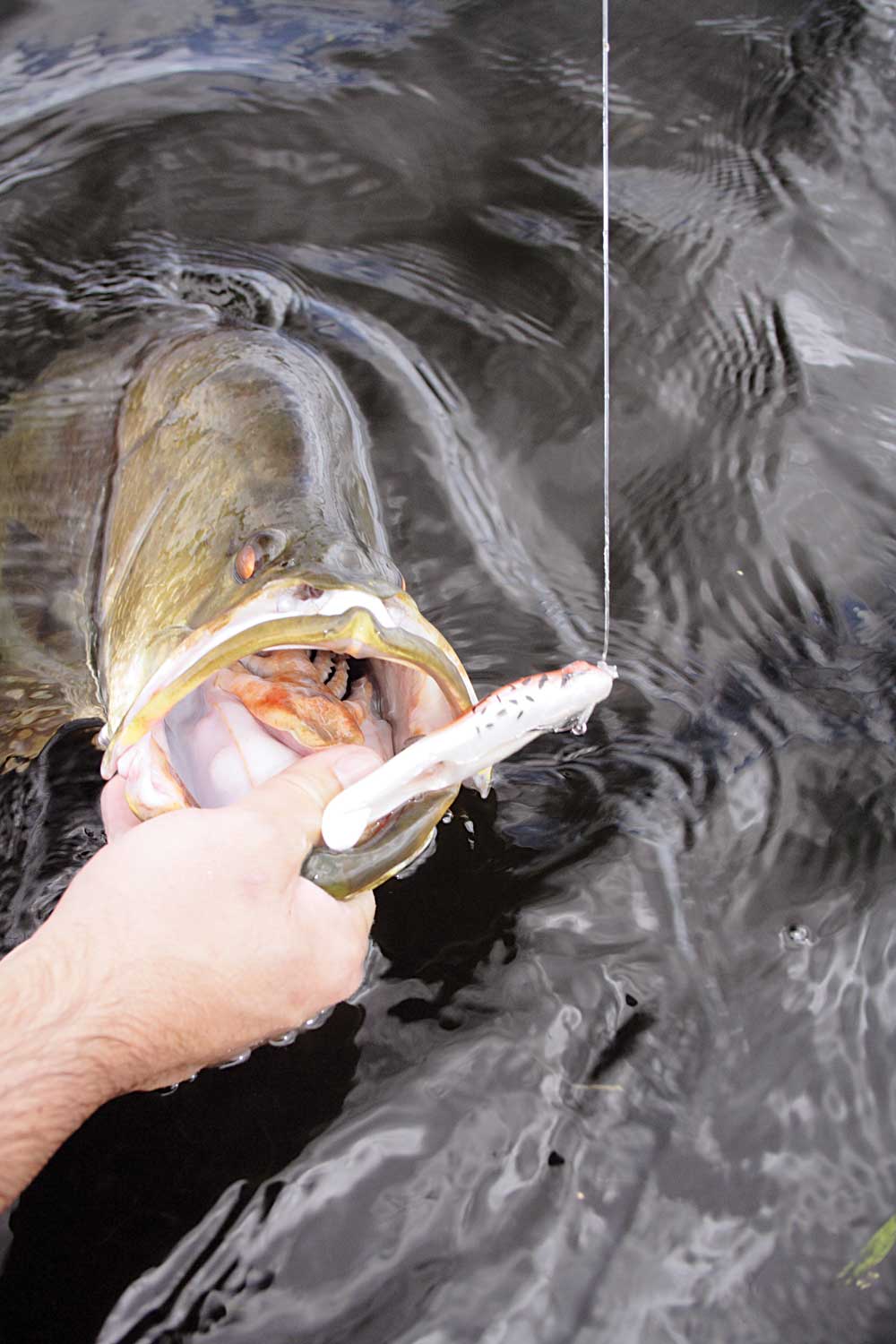
Plastic frogs have become a popular lure choice for fast retrieves.
Fast Retrieve Lure Choices
There are many lures that will work well when using fast retrieves for barramundi. I have settled on a few that are successful for me, but I urge you to experiment with a range of lures that you believe will catch fish. Just make sure they swim well at speed.
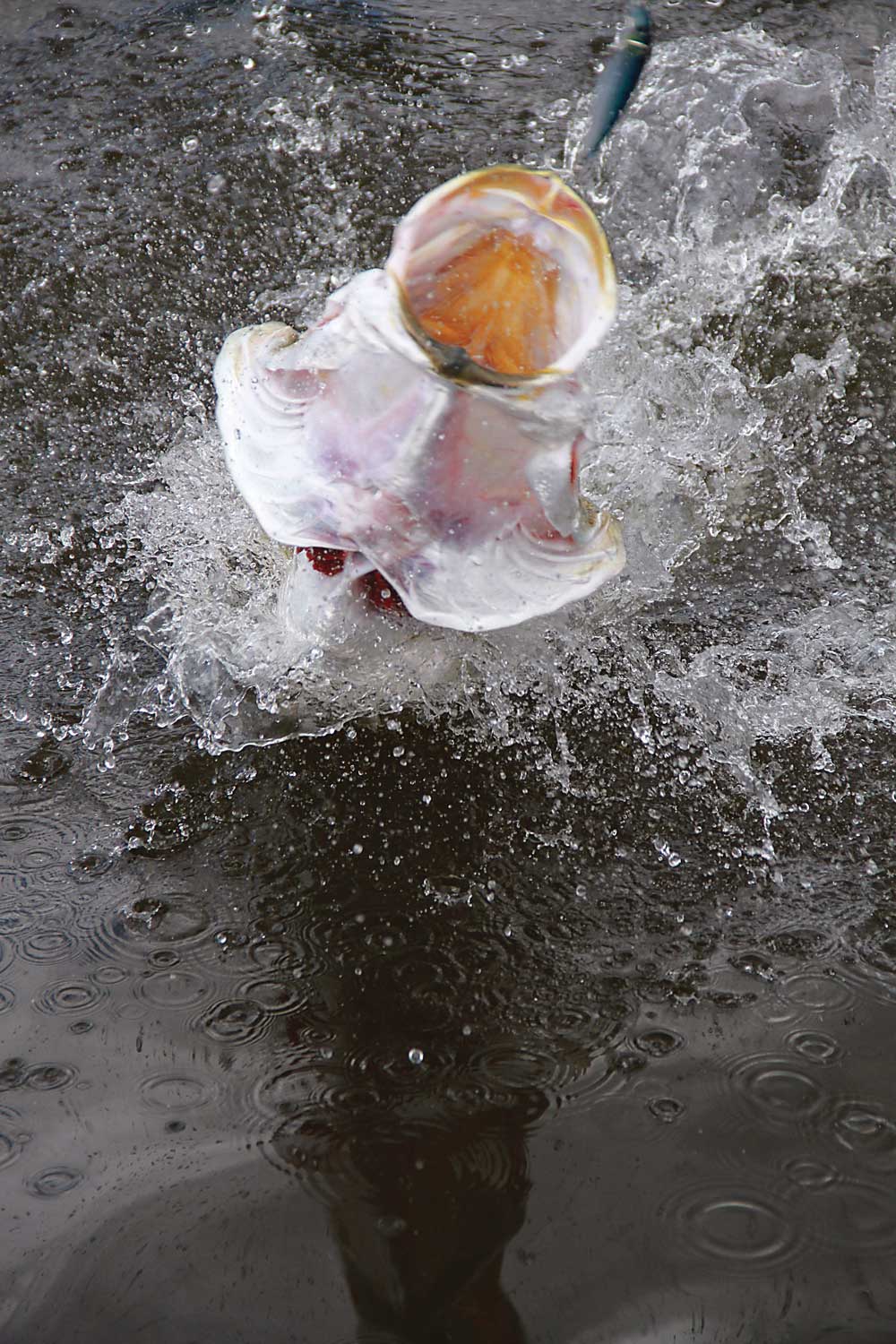
Get your retrieve speed right and it won’t be long before you are treated to some spectacular leaping action!
Soft Plastic Lures
I’ve long been a fan of the Squidgy Slick Rig. As a plastic for this technique, they are awesome straight out of the packet. The main reason I love these plastics so much is due to their versatility. There aren’t too many plastic lures on the market that won’t do barrel rolls or swim unnaturally when retrieved at high speed. I am certain these lures were never designed for this style of fishing but through some good fortune they just happen to be sensational lures for the barra burn technique. The original Slick Rig (not the Pro Range) swims perfectly at a range of retrieval speeds. You’ll do well to find other plastics that you can wind flat out that look just as good in the water. Both the 110 mm and 130 mm versions work brilliantly; as a rough guide I use 110 mm Slick Rigs for burning over the top of weed beds, and the 130s for deeper, open water applications.
The above principles were the cornerstone of the thought process on the fast frogging technique that Craig Simmons and I came up with some years back during an ABT Barra round at Awoonga Dam. There was a huge weed bed loaded with fish; however you couldn’t throw anything in there without the lure being fouled up. Fouled lures mean spooked fish; we had no other alternative but to fish a surface presentation. Craig and I resorted to using the U.S Zoom Horny Toad lures and fished these frog imitation soft plastics across the top of the weed. A fast retrieve produced plenty of fish for us and ‘fast frogging’ was born. In the 100th anniversary edition of Freshwater Fishing Magazine, Starlo rightfully reported that although plastic frogs have been around for an age, this was something completely different and a new discovery in how they are fished.
The Zoom Horny Toad gets my vote when fishing fast surface and sub-surface retrieves, purely for its versatility. It will swim brilliantly at dead slow speeds and continue to perform during flat-out surface frogging retrieves. The 4” Z-Man Hard Leg FrogZ is also a versatile surface frog, and for windy conditions you can’t beat a Squidgy Boof Frog. It’s loud and can be cast a long way, but I do find the more subtle frogs like the Zoom work better when it’s glassed out. Keep in mind the Boof Frog was never designed for a slow retrieve. It’s a speed frog through-and-through and a great one at that. Apart from gigantic barra it has caught a whole range of big pelagics like kingfish and tuna, queenfish and Spanish mackerel. The TT SWS 6/0 hook in 1/8th is the hook of choice when using these lures and it’s a proven performer.
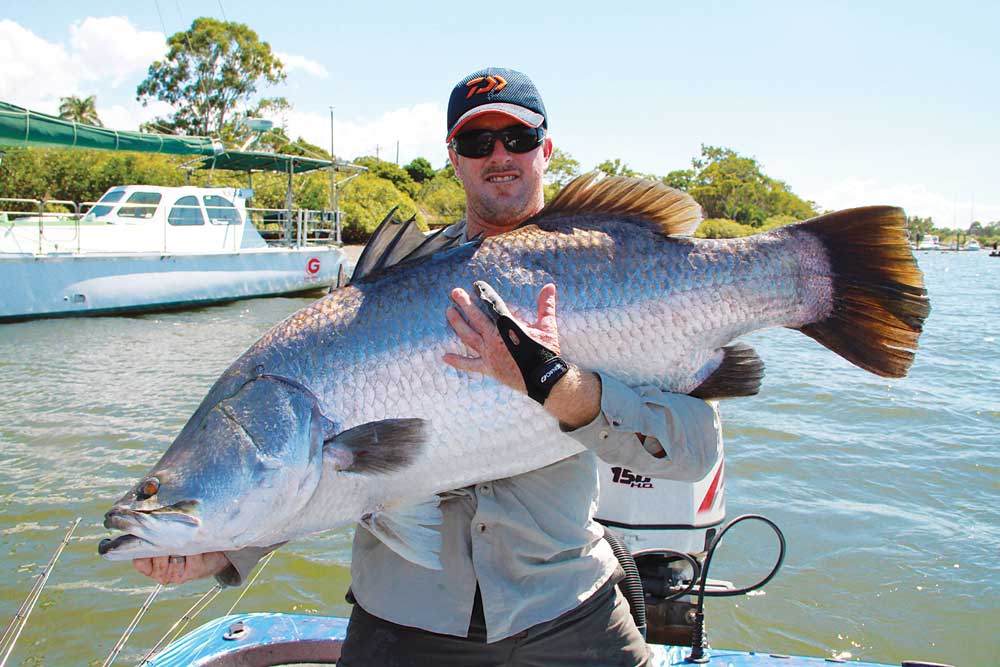
Don’t for one minute think that Big Barra can’t be caught using fast retrieves. In two casts, Richard Potter nailed a 124 cm Barra, and on his very next cast hit pay dirt with this PB monster 125 cm fish utilising reaction methods. You’ll never know if you never change.
Harder Options
There are most certainly other lures that work well when using reaction style techniques, including hardbodied lures like B-52’s, Bombers and a host of other shallow running lures. A retrieve that consists of interspersed high-speed sections with occasional pauses should promote some interest wherever you fish. Keep your options open and check out all your lures and softies, you’ll find out quickly what you can and cannot wind fast.
 Summary
Discovering the effectiveness of high speed retrieves when targeting barramundi has changed the way in which I fish. The hardest aspect of catching fish when using this technique was to initially believe that it worked. Fishing a fast retrieve with the belief that it actually works is the key ingredient to getting that first bite. I urge anyone to get out there and have a go at life in the fast lane, just remember it’s not a magic fix to your barra tough days, but it is an incredibly important string to your bow when a reaction bite is the pick of the crop. Happy hunting!
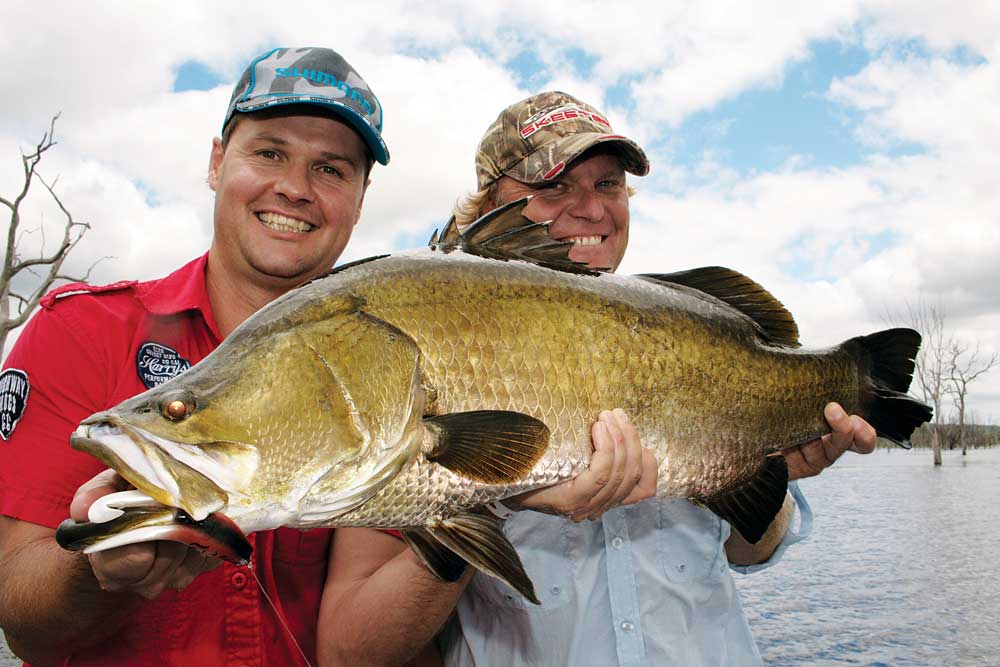
Paul Worsteling and Brett Wilson share a grin after capturing this beautifully coloured weed dwelling Awoonga Barramundi using the fast frogging technique. Although speed retrieves won’t work every day, don’t ever rule out certain styles or techniques.