There was a time when Scott Gray religiously chased kings with livebaits but nowadays he prefers hitting the surface with poppers and stickbaits!
Pics by Scott Gray & Nick Murrell
Each year by about early December the local water temperatures have either reached or exceeded 16°C and schools of kings arrive in the shallow coastal waters along the south-west coast of Victoria. This phenomenon does not only occur in this region though as ‘The Rip’ at the entrance of Port Phillip Bay and Wilson’s Promontory also receives their fair share of fish.
The kingfish fishery in Victoria is nothing short of excellent and it has taken many years for some to see it for what it actually is. While there are plenty of locations to target rat kings in the 2 to 6 kg range there are in fact plenty of fish available in the 10 to 20 kg range if you put in the time. While some fish in South Australia may dwarf these better quality fish, they still provide first-class fishing opportunities and it’s not uncommon in my region, particularly along Portland’s north shore to expect to land fish up to 15 kg each season on surface lures.
 Kings prefer to hunt in the shallow warm water, sometimes less than a metre deep. Most of my top-water fishing takes place between 2 and 10 m of water, so when the water is clear it’s easy to get their attention up on the surface. Often you’ll find kings holding up in sand holes between reefs whilst hunting for gars and squid; using their counter shaded bodies to great effect.
There are two approaches to take when chasing kings; passively whilst anchored up and being patient or by actively going and finding them yourself. Now there’s always times when patience will score the strike, but the amount you can learn about the fishes feeding behaviour, habitat and movements by actively fishing is second to none and I think it’s made me a better angler over the years as a result.
Now before I get into it any further, there are plenty of days where I’m left with a sore arm from casting with no rewards, but it’s the days when you find the fish that you really remember. When you actually find a good patch of fish and get them to yourself, multiple catches of double figure fish are common. There’s nothing like a pack of marauding kings over 10 kg trying to slam your popper or stickbait off the surface! If you’re fishing with friends these sessions usually end with triple hook-ups and drags screaming all over the boat.
 Popper or Stickbait?
Ultimately it’s all about finding the fish and actively covering the water. Casting stickbaits and poppers certainly provides more opportunities to find fish before drawing a strike. Kingfish are inquisitive and will regularly feed out of reaction to a bait or lure. Often just the action of a livebait isn’t enough to fire up the fish which is why I prefer to use lures over livebaits. Even if the fish don’t eat the lure you can refine your technique once you know where they are. Most times you will only get a single chance of a strike and it’s converting these opportunities that will catch you more fish.
Hot days and calm, clear ocean waters provide the best conditions for surface luring. During these times your lure will make the most disturbance; ensuring the best fish attracting ability. After all, kingfish are visual predators and are primarily pelagic in nature, preferring the clear blue ocean water.
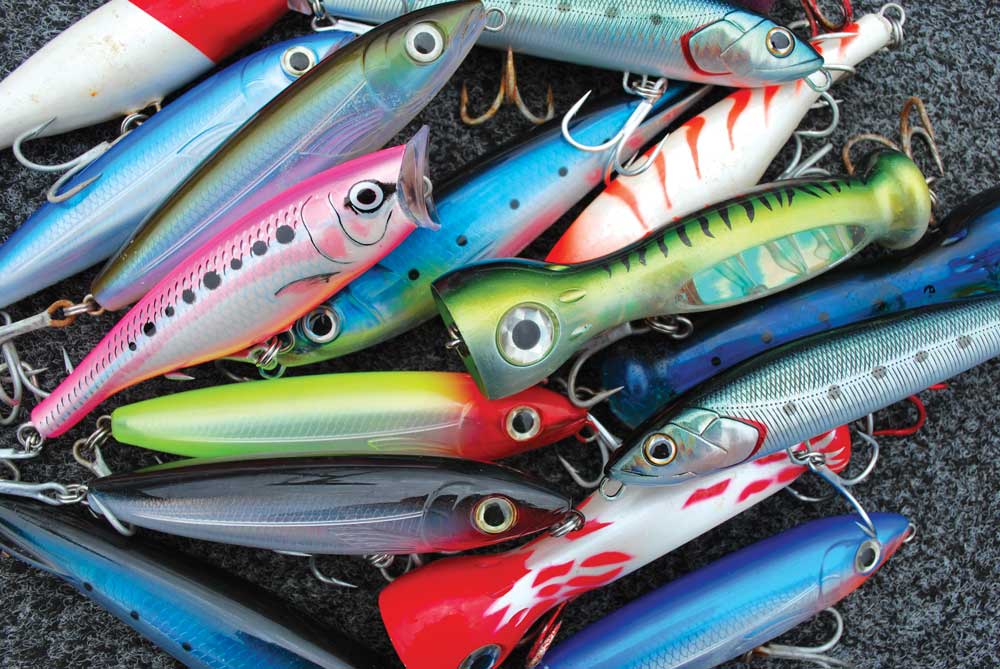
My first choice of lure on any trip is a popper. They make a lot of noise and create plenty of disturbance; a classic selection for achieving a reaction strike. While they are perfect searching lures, poppers tend to fall over in choppy conditions as they become harder to work effectively. At these times it’s probably better to try a stickbait as they bounce and slide over the chop more efficiently and are less likely to tangle. Stickbaits are also ideal in situations where you can see the fish and the more subtle nature is less likely to put the fish down, particularly when the fish are spooky and there is heavy boat traffic. I usually have two or even three rods rigged in the rack because when it all happens you may only have a second or two to present another option. I usually fish with a popper and have a stickbait rigged on another rod. Be cautious about presenting the same lure too many times to a school of fish as you will notice that with each cast they may lose interest in lures all together.
While it is easy to head out and select from a huge range of poppers and stickbaits on the market there are a handful that have been very effective for me. You can spend as much or as little on lures as you like and some friends of mine aren’t shy of spending up to nearly $170 on a single lure! On top of the expense of these models you usually also have to order them from overseas and this can be risky and inconvenient. This approach is certainly not necessary and there are plenty of lures on the Australian market in the $20 to $40 price range that come with good quality terminals and will catch good fish. If there’s one popper to put in your kit then it’s the Williamson Jet Popper in the 5 1/4 inch model. I have used these to great effect and for this reason I don’t use any other type of popper.
When stickbaiting I prefer 4 to 8 inch models with my favourite lures being in the 5 to 6 inch range like the X-rap Walk 13 or the Daiwa Slider 14F. Not only are these bite size, they are also perfect to cast on light spin tackle. This is one of the reasons I prefer the use of smaller poppers and stickbaits on light threadline tackle. You can cast them all day long with ease, especially when it’s hot. I’m yet to experiment with large stickbaits and poppers back at home, despite having success with them overseas, this may be a matter of course but for now I’m really enjoying my fishing with smaller lures and lighter tackle.
Colour is not a big issue for me and I’ll usually use bright colours with a bit of flash, but when I’m fishing at dawn or dusk I prefer darker colours as they create a better silhouette on the surface.
Techniques
I always like to be in motion when I’m surface luring as it allows me to systematically work drop-offs and holes whilst covering a lot of water. I almost exclusively use an electric motor for this purpose and being dead quiet it offers a reasonable amount of stealth and allows me to position the boat perfectly for each cast. This is especially important when you can see the fish on the surface.
Keep your lure in the strikezone for as long as you can. There really is no need to cast and retrieve your lure at a great rate of knots. Poppers are excellent lures for this style of retrieve as they make a lot of noise and can be fished very slowly. People think that kingfish are just violent predators and the faster you retrieve the more likely they are to eat it – this is not true! In fact, a lot of fish will chase the lure right to the boat, but then shy away before they get a chance to eat it if retrieved too quickly. Try varying your retrieve rather than speeding it up. The longer your lure spends in the water, the longer it’s in the strikezone!
Surface fishing is visual and that’s why we love it. It allows us to watch the action of the lure and the crashing strike. Remember to keep your eyes peeled for yellow tails sticking out of the water, particularly when it’s calm. They are easier to catch when you know where they are.
Losing big kings is a fact of life, but over the years I’ve found that a more gentle approach is often required when chasing them in shallow, reefy terrain. I rarely lose more than 10 percent of the bigger fish by simply being patient and running only 3 to 4 kg of drag. I almost exclusively fish with light to medium threadline spin outfits. When using light gear and minimal drag the fish tend to stay away from the bottom more than if you just lock up and go for broke. In fact a light drag will just about always land you the fish – it will just add time to the length of the fight. Most importantly, the drag setting I use is not only employed to help impart some control over the fish, but ultimately to ensure the hooks go in on the strike as the larger fish have reasonably hard mouths.
Fishing for kings is never an exact science; in fact it’s often more a game of chance and probability. Give yourself the best possible chance of finding the fish and I believe you too will be hooked on surface fishing for kings!
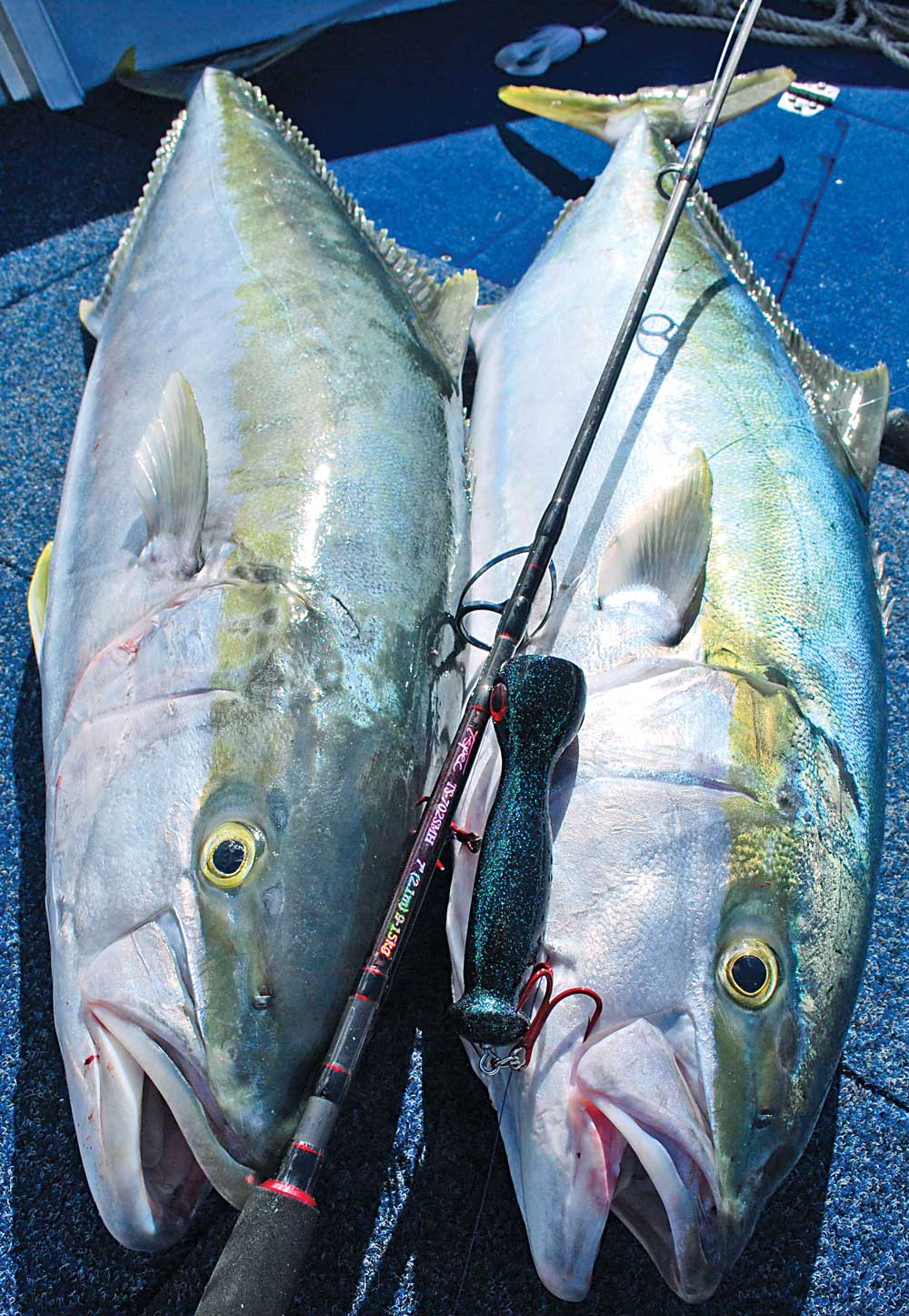
A brace of big kings taken on a williamson jet popper