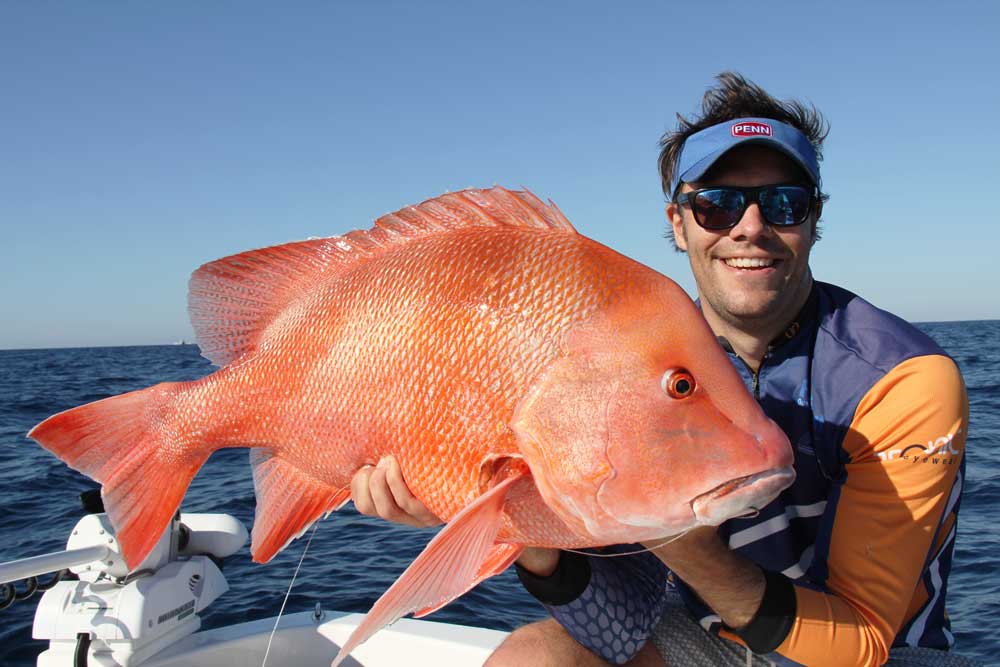
There is nothing easy about catching red emperor. That’s fact. They’re elusive, tend to be most active at night, fight ridiculously hard and sharks like to eat them when you do finally hook one. Despite all of these things Chris Raimondi can’t get enough, and here he explains why.
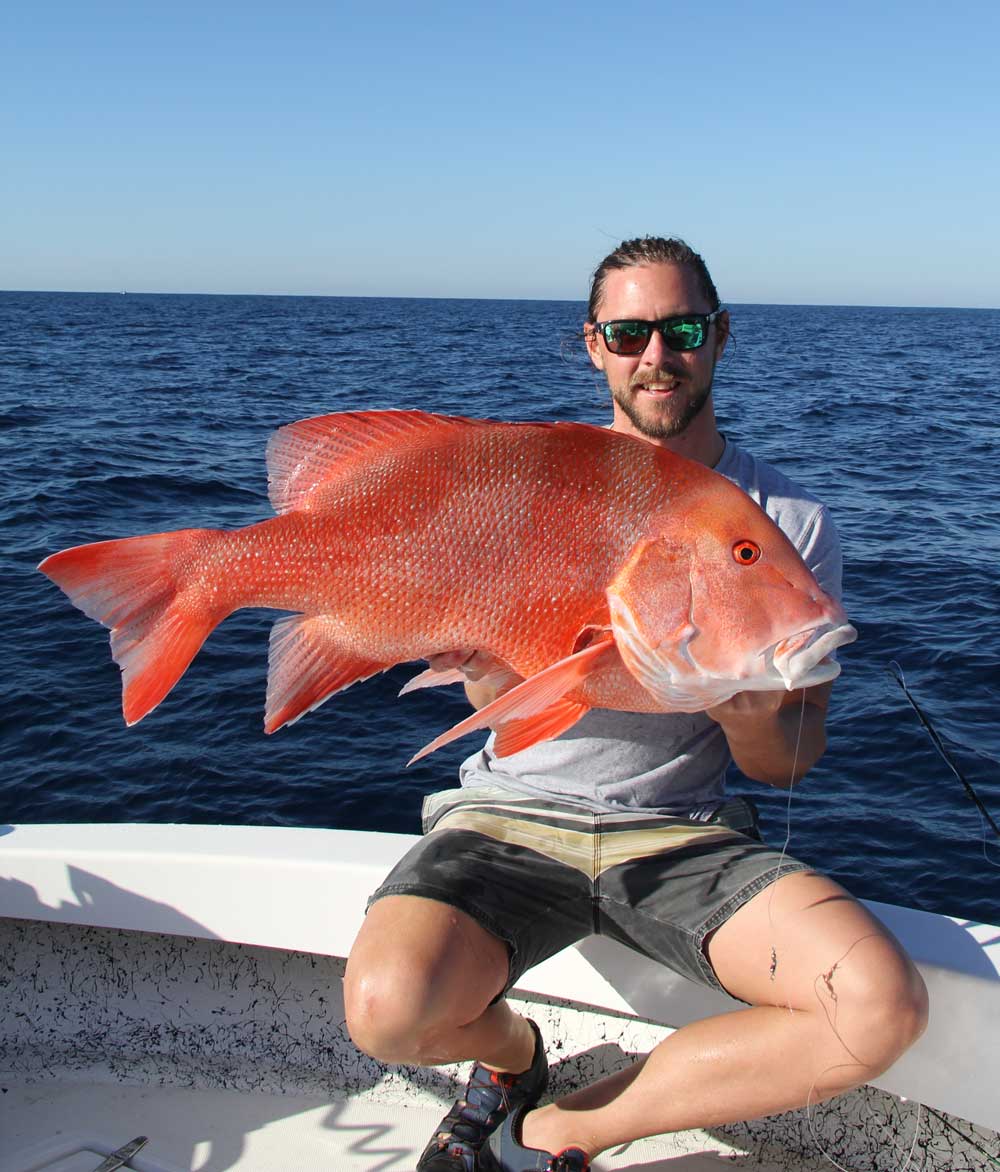
A fish that would put a smile on most angler’s face
You might consider me crazy for being obsessed with this particular species and I probably can’t argue with that summation considering I bought myself a 5.5m Gale force centre console rather than an 8m plate boat for my offshore fishing. A number of factors went into my choice of vessel with versatility ultimately the deciding factor. However, my obsession with catching red emperor was probably not aided by my decision with the Galey not designed for bar crossings and long overnight trips offshore. Nevertheless, my dream of catching reds remained and simply required a slight shift in thinking.
In the last edition of Sport Fishing Australia I profiled Fraser Island as an offshore fishing destination and one of the most versatile fisheries in the country. One of the big factors in its favour is that Fraser Island’s offshore waters aren’t all that easy to access. At either end are two fairly notorious bar crossings; the Wide Bay Bar to the south and Breaksea Spit to the north. To take these on safely and head to the wider offshore grounds, a boat of the larger variety is ideal.
The other option is to tow a boat up the Fraser Island eastern beach and launch in the surf at Orchard Beach, just north of Waddy Point. There is nothing easy about any of that, with the Fraser Island sand stopping many a boat and trailer in its tracks over the years. However, if you’re towing a boat up the island, the 5.5 to 6.5m range is perfect; it’s light enough to cause fewer hassles on the beach but big enough to fish comfortably offshore.
When you roll up all of these factors, it raises the degree of difficulty in accessing these waters and ensures that fishing pressure on the area isn’t nearly as intense as it could be.
Every trip to Fraser is filled with anticipation and plenty of nerves. The beach conditions are never the same so you need to be on your guard from the moment you venture onto the sand as one small mistake can prove costly. Once you finally launch your boat and get offshore, it’s a relieving feeling but then it’s time to get down to business.
Considering you really need to beach launch in the daylight, your plan is super-important given your morning bite period window will close fairly swiftly. A clear plan of attack is the key. Get to your first spot quickly, assess the conditions and if things don’t go to plan, adjust quickly and activate plan B or C.
On a recent outing, we launched successfully but had about a 45 minute run to our first spot, with a few other areas in close vicinity. By about 7.30am we were applying plan A with very little success. A maiden legal red emperor in the Galeforce was the goal, as it had been for the precious few trips off Fraser Island over the past twelve months.
By 8.15am it still wasn’t happening so we moved on, sounding around a nearby area found on a previous trip that was expected to hold reds. All of a sudden the sounder lit up with a big school of bait pushed hard against a small rock on the bottom in 53m of water.
The bait school was scattered with large red blotches on the sounder; a tell-tale sign that there were some feeding reds below us. During daylight hours it’s vital to find bait schools if you want to consistently catch red emperor. Although you may catch one or two (or multiple at night) fishing hard, nasty reef structure, feeding reds will roam like cows in a paddock, looking for the best source of food.
Visually, this show on the sounder ticked all the boxes and on the first drift, my assumptions were verified. We nailed a double hook up of big, angry fish, both of which ended up in the boat and both of which were the right colour, red!
A 12.1kg model for my great mate Ross Hayes was a fitting fish to christen the Galey and my 6.5kg pup wasn’t the biggest red I’ve caught but it was one of the most special. In that moment, years of time, money, effort and perseverance came to fruition. So many hours of sounding and scoping out areas likely to hold these awesome fish and on this particular day they were chewing.
All of a sudden we were holding red emperor aloft for photos on the casting deck, a moment I’d been waiting for since buying the boat in 2015. On the second drift, it was mayhem once more. Ross was preoccupied with getting his rig back from his 12.1kg beast and while he was doing so, yours truly bagged a nice upgrade; an 11.2kg model.
These fish were extremely aggressive, feeding feverishly;however, with the sun getting higher in the sky and the time approaching 9am, I tipped that it wouldn’t last. On his next drop Ross landed a red emperor on each one of his BKK 8/0 snelled hooks, one legal and one just undersize. This was atrue testament to how aggressive these reds were feeding. As expected, the bait started to disperse and the bite slowed but not before another nice legal red and a few more undersized models were landed. What a morning.
Over the next few days we managed to catch a few more legal reds along with some quality pearl perch and parrot from the surrounding area. Like many reef systems, the fish tend to wise up a little over time under constant fishing pressure over consecutive days. The moon phase wasn’t ideal either, shifting further away from the full moon with each passing day. It is very possible that these fish would have fed even more aggressively at night, as red emperor tend to do.
Finding Them
As is often the case with offshore fishing, the majority of time and effort goes into locating areas which are likely to hold your target species. Reds tend to inhabit waters between 45 and 85 metres. There are of course exceptions to this but to increase your chances of finding a school or two, concentrate your search area to water depths between 50 and 60 metres.
Structure isn’t overly important when locating these fish but the presence of bait certainly is and if you can find both, there’s a good chance you’re sitting on top of a red. Red emperor will roam in schools, particularly during daylight hours, to feed on bait schools in close proximity to the bottom.
An area you’ve caught reds previously might be absolutely bare next trip but there is a good chance the school will be in relatively close proximity so widen your search area and stay patient. Focus your attention to the bottom, setting up your sounder to read in 2 to 3 m increments within the bottom 10 to 15m of the water column. Look firstly for bait schools and then for bigger fish among them,sitting hard against the bottom.
The more tightly packed, the more likely predators are harassing a bait school. High shows in the water column aren’t necessarily a bad thing but they won’t be reds that exclusively dwell on the bottom and among structure. Finding significant reef structure in 50 to 60m of water is certainly not a bad thing and reds will often reside in these areas but that doesn’t necessarily mean they are feeding. In low light and darkness, they’re more likely to bite in this situation.
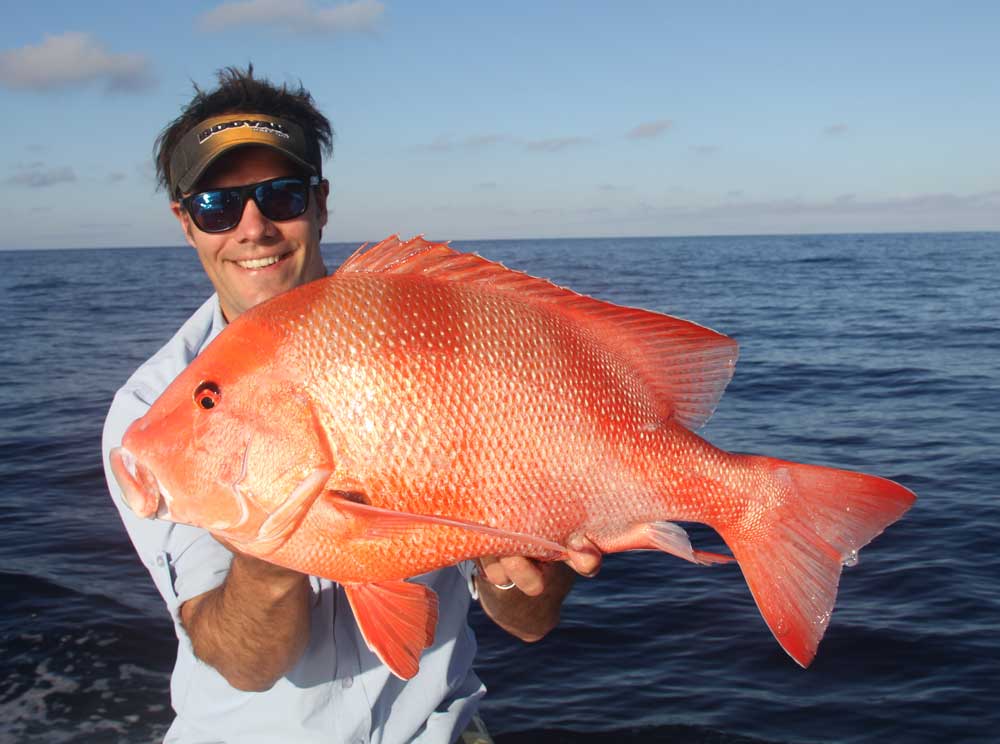
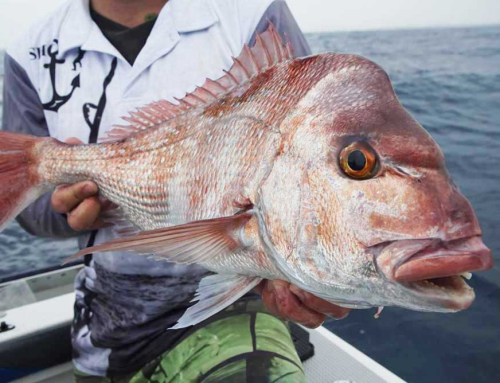
It doesn’t get any better than a big snapper on light gear
Enticing a bite
Bait selection and presentation is a key element to catching red emperor consistently. Reds reside in areas where the current tends to flow strongly and feed hard against the bottom so large sinkers are often required. The larger your sinker, the more it’ll negatively affect the natural presentation of your bait so some using a three way swivel to separate the two will often pay dividends.
Tie your ‘dropper style’ sinker to the bottom swivel and allow your leader and bait to waft naturally from the side swivel. In this scenario your bait isn’t affected by the sinker weight. Ensure your leader is slightly shorter than the line attaching your sinker to allow your bait to waft naturally just off the ocean floor. Do your best to make sure the two lines don’t twist together by continually separating them each time you retrieve your bait. If the current allows it, use a conventional ‘float style’ rig but upsize your ball sinker depending on the conditions.
In terms of hook selection, bigger is better as reds have large, hard mouths. Pairing a couple of 10/0 BKK octopus hooks is about as good a setup as you can run. Smaller hooks, like 7/0s or 8/0s will give you a better chance of landing smaller by catch like parrot, red throat, hussar and pearly perch but you do risk missing the ultimate prize. A three gang set up of Tru Turns or Mustad Big Game hooks is also very effective but ensure any hook you choose has a fair gape given the size and toughness of a big red’s mouth.
As always, fresh bait is best. Large flesh baits are perfect with hussar, tailor and mullet fillets very effective. Squid, yakka and slimy mackerel are also dynamite. Don’t be afraid to drop big baits for reds as they’ll seldom let a big meal worry them if they’re in the mood. A bigger bait will also take longer for smaller fish to chip away at meaning you’re in the strikezone for longer.
This is a very important factor considering reds are typically located in small, concentrated areas in areas of high current flow. That means quick drifts unless conditions allow you to anchor so the longer your bait is on the bottom and the more attention smaller fish pay to it, the more likely it’ll catch the eye of a nice big red.
Landing Them
Know your gear. Fishing hard to the bottom for big reef species means you’ll need a fair bit of drag pressure and some strong, reliable line. Whatever your drag setting and line selection, ensure you’re confident with your choice.
Braid main line in the 50 to 80lbrange is ideal but run 5 to 8m of monofilament main line at the business end. Braid has no stretch which is brilliant for bite detection but not ideal for dealing with the big head shakes of a red emperor coming up through the water column. Using braid means you’ll need to apply pressure to the fish for the duration of the fight as any slack line coupled with no stretch makes it easy to pull the hooks.
The 5-8m of monofilament importantly adds an element of shock absorption to your set up. Leader material is also crucial. Anything from 60lb to 100lb fluorocarbon or monofilament will do the job depending on the amount of sharp reef structure you’re fishing. Drag wise, run it tight and give the fish very little in the first 5 to 10seconds as they’ll brick you in the reef very quickly.
A solid rod is also a must with a tip on the softer side a valuable addition to help aid the shock absorption factor already touched on. Jigging rods have actually become popular with a lot of anglers who chase reds offshore as their action tends to suit the need to go hard at these fish in the early stages of the fight.
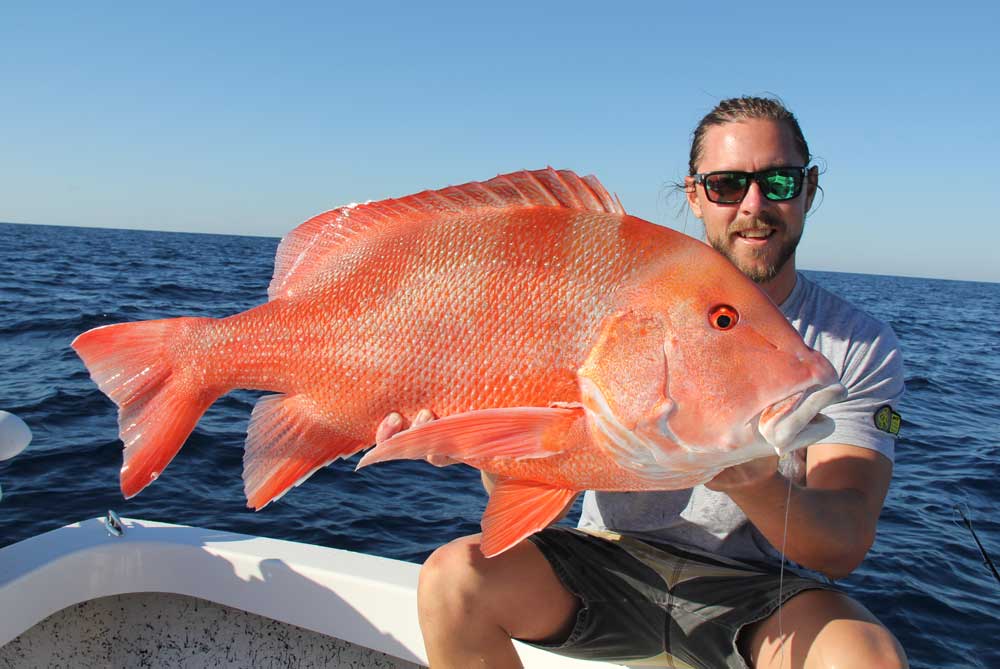
Another cracking snapper
Think outside the square
They are the kings of the reef for a reason and there is nothing easy about consistently catching quality red emperor. However like with anything, if you put the time and effort into chasing them and stay true to the things you learn along the way, the day you nail them will be one to remember.
No matter how big your boat or how much experience you’ve had, there are always ways to target and catch the most sought after species, you just need to think outside the square. Boats with casting decks can still catch reds.
Chris Raimondi lives in South East Queensland working at the BCF head. Chris is into everything angling; from bream and barra to snapper and red emperor. Chris’ role at BCF means he is privy to seeing many of the newest lures on the market before they hit the stores and is quick to give them a swim at any opportunity!