Nigel Webster has spent years fishing our Australian mainland trout regions. Living in Queensland means there is little opportunity to tangle with these fish but he has found that a northern address does not mean you are completely isolated when it comes to chasing a few of our introduced freshwater favourites.
The Trout Bug
Leaving the New South Wales countryside to take up residence in Queensland, I remember thinking its going to be a long time before I find the urge to go and chase trout again: freshwater trout that is, not the really tasty red ones that live around our coral reef. The funny thing about fishing is that it’s a lot like other areas of life: a change can be refreshing. After several years of chasing many of our tropical species, I recently found myself thinking about freshwater trout. It may have had something to do with the autumn cold setting in, but something in the back of my mind reminded me that this was often a great time of year to chase a trout. I dismissed the thoughts as a passing moment only to revisit them a short time later when mates of mine talked of some great trout fishing they experienced a short drive from Brisbane. That was the catalyst for a quickly arranged trip to new fishing grounds. The trout bug had bitten again, and I had to satisfy it; the good news was that trout fishing in southern Queensland was not as inaccessible as I had previously thought it to be.
 Queensland Trout Geography
The northern New South Wales highlands are well-known for producing some top-notch trout fishing. The New England area inland from Coffs Harbour is the approximate centre of this scenic trout fishing region; it stretches south from Armidale towards Tamworth and then north to Glen Innes. Local countryside is high, cold and home to plenty of small rivers and streams that support local trout populations. If you are like me then you don’t mind driving to a fishing destination; just as long as it isn’t too far! For this reason I researched the closest available trout waters to Brisbane. I was very pleased to find that an approximate drive of 4 hours would have me in Glen Innes, home to some engaging rainbow trout fishing. I wasn’t so happy to hear the temperature was reaching lows of minus 5°C at the time I planned to open the car door. Brisbane anglers are best advised to head south to Grafton, take a right and head through the hills towards Grafton which puts you in the midst of plenty of trout fishing options. The drive through the hills is magnificent so the trip is far from boring.
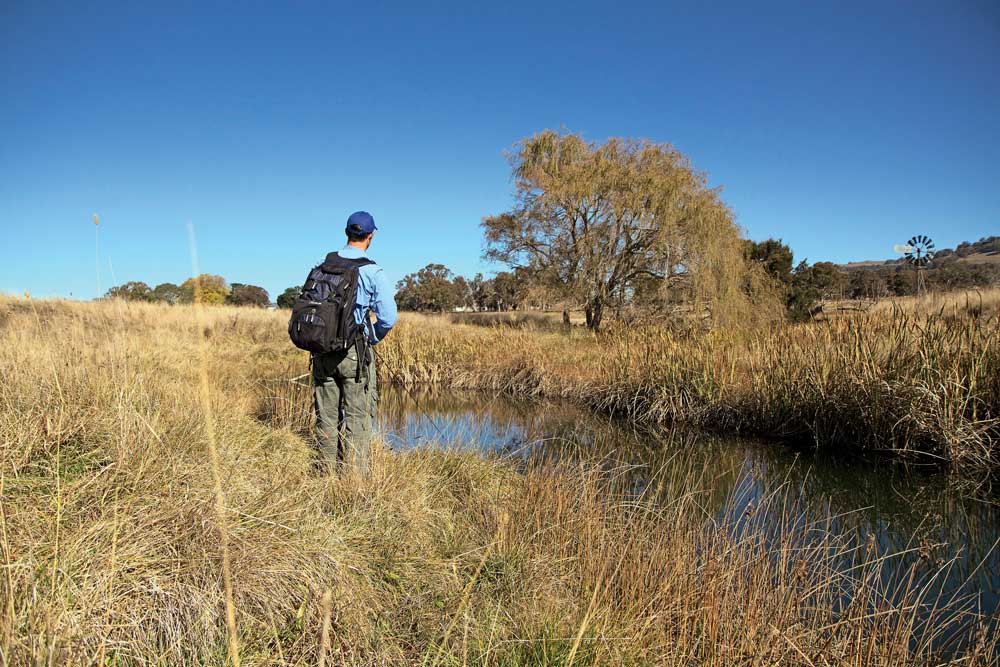
Tight casting around tussock banks and fishing the head of pools is a popular strategy in these parts.
Glen Innes Options
The trout waters in the Glen Innes area all branch out of the Severn and Deepwater Rivers and the slower-moving section of these systems also support native species such as cod and perch. Much of the trout water you will encounter in this region consists of smaller creeks and streams. Don’t let this put you off exploring however, as it doesn’t take a lot of water to sustain healthy populations of trout in this part of the world. The area has been unseasonably dry and when I recently visited, the creeks were flowing low and slowly, the good news was that the trout were happy, plentiful and feisty. Although brown and rainbow trout are stocked in local waters, the rainbows are by far the most common species encountered. Fish of 500 g to 1 kg are common and the occasional larger fish can be found. The conditions favour the local rainbows as all the fish I have seen here are in tremendous condition.
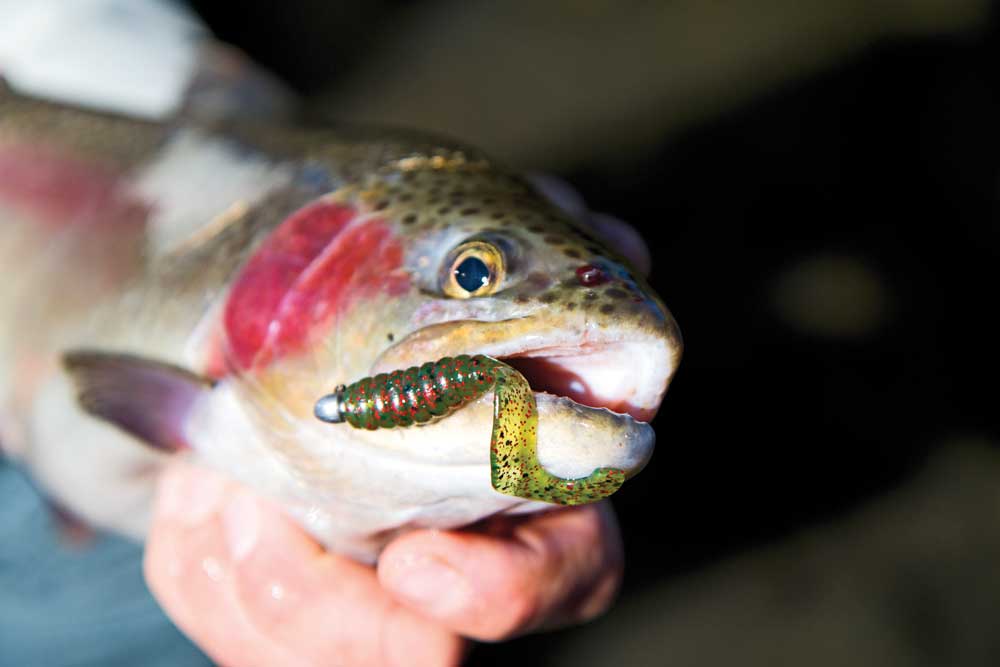
A well-conditioned fish that fell for a slow-rolled Z-Man Grubz.
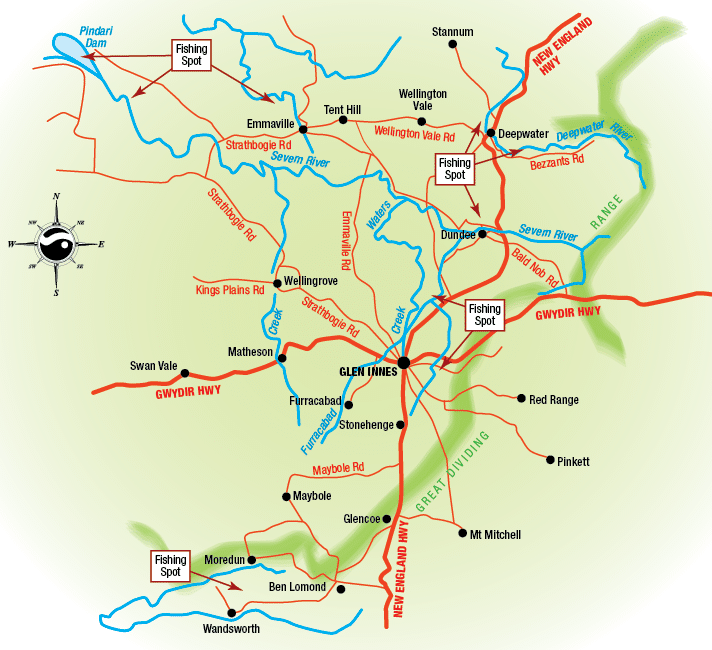
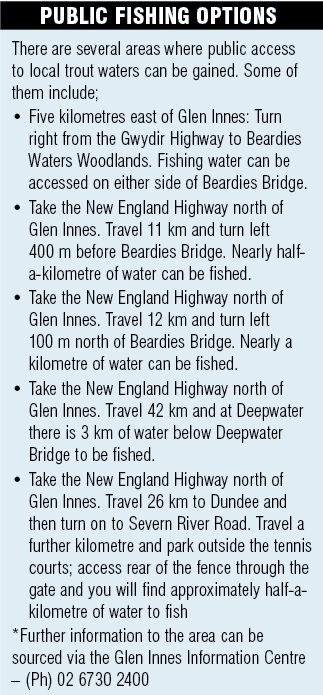
I spent most of my time exploring the creeks that feed the Severn River and found them to be characterised by small to medium-sized pools that were separated by tiny chains of rapids. The creek waters are clothed by tussock plains and scattered forest and are relatively easy to access. There are areas that hinder casting and these locations lend themselves better to spin fishing as opposed to fly fishing. Much of the waterfront access is found on private property, but there are several areas where water can be accessed by the public. A map derived from information provided by Glen Innes Tourist Information has been included to show where these locations are. Some time spent politely asking landowners for access may provide further options, but be courteous and please look after the area if granted permission to fish private property. Trout in the rivers and creeks can be targeted throughout the area in the times between the long weekend at the start of October and the long weekend at the start of June. The winter periods from June to October are part of the closed season for trout.
Tackle
Trout can be caught on traditional spin and fly fishing equipment in the Glen Innes area. Dry, nymph and streamer type flies will all tempt local inhabitants. The waters are poor in available baitfish supply and predators will readily climb on anything that resembles a good feed of protein. I’ve left the fly rod at home recently and decided to target fish primarily on soft plastics and small hardbody lures. The ease of lugging around a light-weight spin rod combined with the simplicity of casting small artificials in sometimes restricted areas makes this an easy and effective approach for catching fish in these skinny northern waters. Casting distance here is rarely an issue and a 6’6” and 1 to 3 kg weight spin rod will make presenting lures an easy task when the bankside vegetation becomes dense. A 2000 size threadline reel loaded with 4 to 6 lb braid that is completed with a couple of metres of 4 to 6 lb breaking strain fluorocarbon leader will complement the spin rod perfectly.
A number of lure types will tempt local trout. The hardbody brigade always catch plenty of resident fish. Popular options are shallow-diving bibbed lures in the 5 cm size range. Rapala trout imitations, Berkley, Maria, Megabass and Shimano prototypes are all popular with local anglers. Good mate of mine Steve Wilson spends plenty of time up this way, and he is fast becoming a fan of the 46 mm Berkley 3B Sub Dogs. These sinking stick-minnow lures can be twitched and paused seductively and definitely get aggressive reactions from these highland rainbows.
Soft plastic lures are becoming increasingly popular with trout anglers in Australia as they offer great versatility. I have used them to good effect on lake and river fish over recent years but wasn’t sure how they would fare on local super-skinny water fish. Recent visits, one of which we filmed for a Sport Fish DVD segment has shown that the plastics came up trumps. We recently captured some great footage of rainbows climbing all over Z-Man lures in shallow and clear waters. Two lures were stand-outs: the 3.75 inch Streakz Minnow and the 2.5 inch Grubz. Natural colours in greens and browns worked well as did anything with some red and pink in it. Light jigheads with super-sharp fine wire hooks assisted the soft plastic presentation and hook-up rate respectively. To add some flash and vibration to the equation we also armed ourselves with some TT Rev Heads. These jig heads carry a metal blade that flashes and spins when retrieved. Spinning blades have always worked on trout so it stands to reason that these will be a winner when fished in conjunction with a tasty looking soft plastics lure. In the shallow water, a 1/8 oz Rev Head on a size 1 or 2 hook will cover a lot of applications.
 Approach
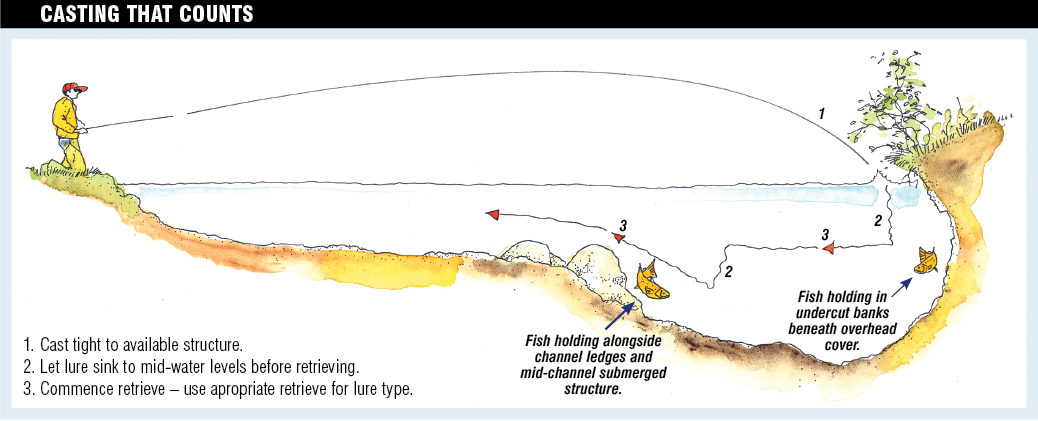
Catching trout in shallow and narrow waterways can be a challenge. A stealthy approach, subtle presentations and pin-point casting accuracy are a must. Local fish will hold in different areas of the rivers and creeks at varying stages of the season and on a daily basis. Every time you begin a new fishing day, try to quickly establish what fish holding patterns can be identified. A good checklist includes trying to ascertain if fish are predominantly holding:
1. Towards the head of pools where running water enters a deeper section of river;
2. Along the margins of the pools where undercut banks and overhanging tussock and foliage exists;
3. Along deeper mid-channel structures, or
4. Towards the tail of pools.
Once a pattern is identified it may help you determine where to concentrate lure casting efforts.
A good pair of polarised sunglasses is an invaluable tool when searching for fish. Try to slowly approach the water at any stage. Keeping a low profile will also help you to avoid spooking resident trout. Always try to get yourself into a good casting position without the chance of fish spotting you. Casting should be carried out with low and minimal rod movements. The flash of sunlight on a rod blank is often the end of fish catching chances on a given pool.
Techniques
Two lure retrieves will catch you plenty of local fish. These are a twitched and slow-rolled retrieve; let’s take a detailed look at them.
The Twitch Retrieve:
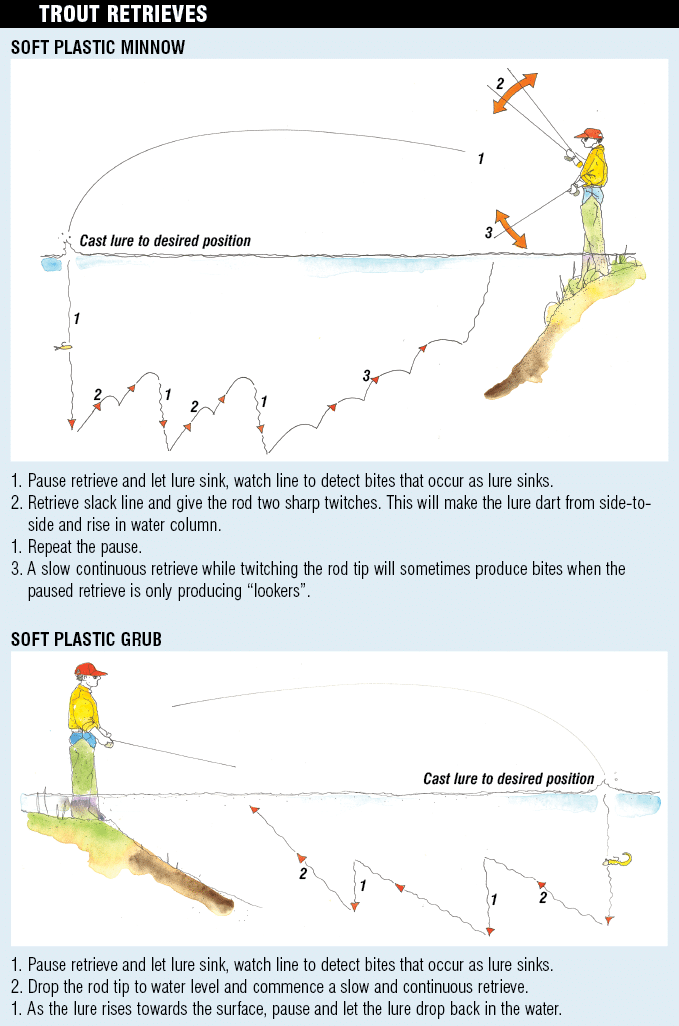
This approach works very well with minnow style lures. I have caught plenty of fish using soft plastic minnows and hardbody stickbaits when employing this retrieve. The retrieve aims to imitate a wounded baitfish. The water you will be fishing is going to be shallow in many cases, which means that lightly weighted lures should be used wherever possible. I like using 3 to 4 inch soft plastic minnows rigged on 1/50 to 1/60 oz jigheads. Always aim to cast up-river of the fish and then work the lure through the holding position of staged trout. Having cast the lure into position;
1. Drop the rod tip and retrieve any slack line,
2. Give the rod tip two quick flicks, followed by a pause. This will make the lure dart side-to-side and then suddenly stop and begin to settle back towards bottom. Many fish take the lure at this stage.
3. Retrieve slack line and repeat the process.
4. Variations to the retrieve include speeding up the presentation. This may mean removing the pause and continuing a slow and continuous twitching of the lure all the way back to the rod tip. Vary your retrieve to establish what the fish want most on any given day.
Many bites will be seen by an angler which makes for fascinating fishing. In the event that visibility is obstructed, watch your line for any unnatural movements. Sideways line movement often suggests that a fish has grabbed the lure. Lift the rod at any stage you believe a fish has fallen for your offering.
 The Slow-Rolled Retrieve:
This is a common style of retrieve when targeting trout. I was using slow-rolled retrieves with Mepp Spinners many years ago to catch fish and the approach still works as well today. The slow-rolled retrieve consists of slowly and continuously retrieving a lure; it is a great way to present vibrating lures such as soft plastic curl-tailed, bladed and bibbed hardbody lures. Local anglers and I had great success recently when slow-rolling 2.5 inch curl-tailed plastics through available shallow pools. Mounting plastics onto flashing jig heads like the TT Rev Heads, had fish literally fighting to get their mouths around these impressive looking presentations. In the event that a standard jighead is used, a good option includes a 1/16 oz weighting and size 1 to 2 hook.
 The trick to catching fish when slow-rolling lures is to establish what speed is best. Experimenting through the course of a day will help you to determine what they respond to most frequently. Another variable to consider includes which depth to best work a lure. Fish will sometimes prefer to take a lure fished close beneath the surface, while at other times will only strike at one fished deeper in the water column. Pausing to let lures sink in the water and by varying the distance between your rod tip and the water’s surface will control the depth at which a lure travels.
Summary
This area is a beautiful place to visit and chase trout. Its relatively close proximity to the Queensland border means northern anglers wishing to chase a few spotted visitors can do so without too much drama. The fishing is visually engaging and there is a good stock of local fish to ensure you will always see a few fish on any given day.
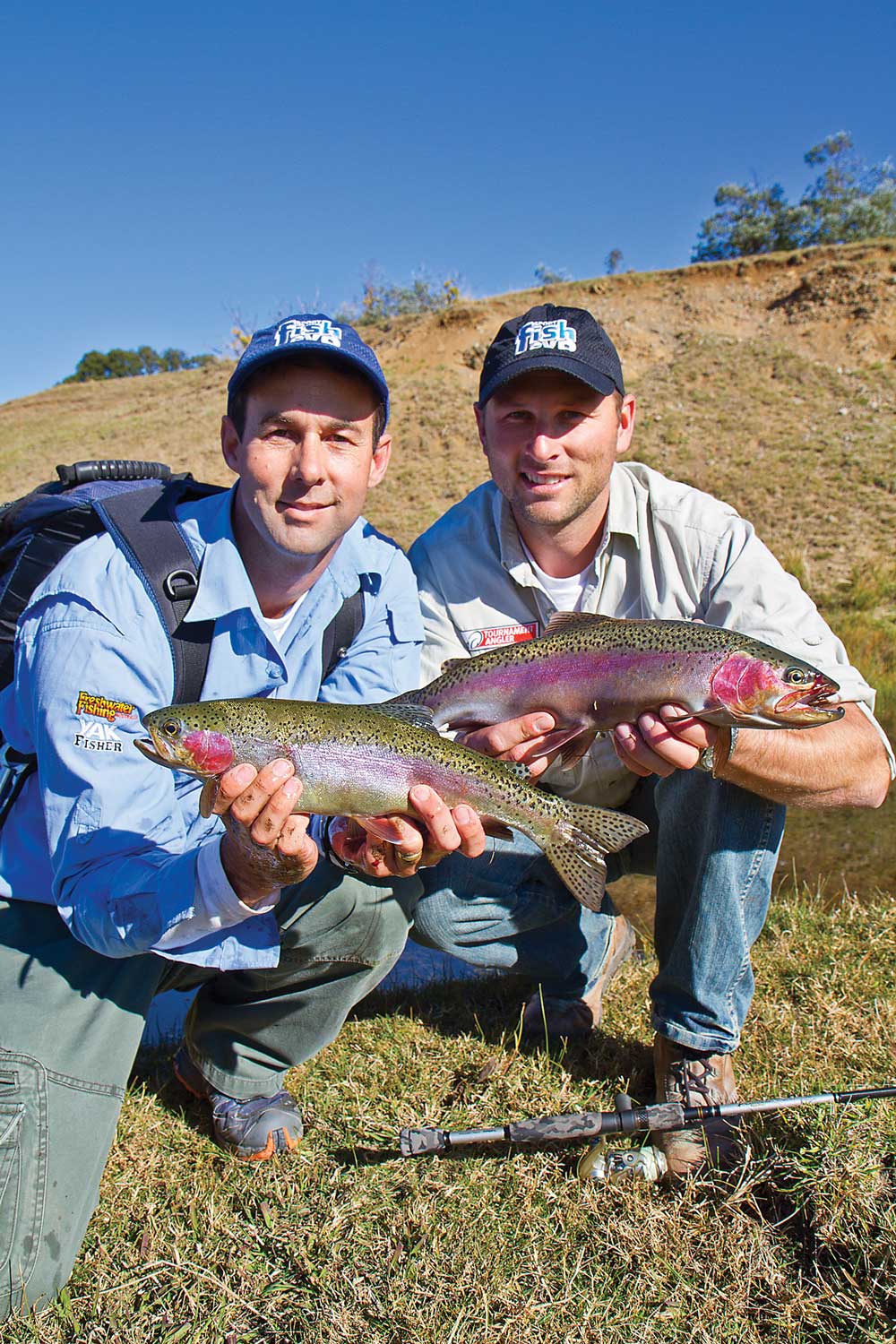
The waters may be skinny in these areas but the trout are often plentiful and aggressive!