
-
 Fishing Atlas for Murrumbidgee River is a full-colour guide that details the recreational opportunities along the length of the river from Gundagai to Balranald. This guide lists every public access point to the river along this length, the river conditions, fishing potential, boat launching facilities, campsite quality and the availability of items such as toilets, barbecues, tables and seats. GPS coordinates are supplied for the approach to every entrance to the reserves, parks and other river access points. Plus there are plenty of fishing hints and fish identification and capture information to help make your stay in the area successful.
 -
 The Queensland Fish ID Guide is the definitive guide to QLD fish species and how to catch them. Contains accurate fish illustrations, descriptions, and diagrams of the best rigs to catch each fish, this book is an invaluable reference for any angler, fresh or salt water, wanting to identify their catch.
 -
 The Landbased Fishing Guide to Sydney Area features all of the top landbased fishing locations in the region, covering rivers, estuaries, beaches, piers and jetties. Each location has a detailed guide and photos, and there's also sections on knots and rigs, bait presentation and a fish ID guide.
 -
 The Landbased Fishing Guide to Port Phillip Bay features all of the top landbased fishing locations in the region, covering rivers, estuaries, beaches, piers and jetties. Each location has a detailed guide and photos, and there's also sections on knots and rigs, bait presentation and a fish ID guide.
 -
 The Murray River is home to the largest freshwater fish in Australia - the mighty Murray cod. In this book Brian Hinson and Bill Classon each draw on over 40 years experience to reveal the best methods to catch one of these legendary fish. There is also information on other fish species found in the Murray River, including trout cod, redfin, golden perch, silver perch and catfish. Detailed maps of the Murray River are included, with notes on the best fishing spots, techniques and more.
 -
 The Snowy Mountains is a world class trout fishery that has a vast array of creeks, streams, rivers, and man-made impoundments full of healthy trout. Many waterways are within National Parks allowing easy access for those wishing to discover the more remote streams and creeks. For those keen to explore the lakes and dams there are endless options available for both land based and boat anglers. The area attracts thousands of anglers every year, from the novice angler to the hard-core sport fishing enthusiast. Andrew McGovern has been hiking, fishing, and exploring all corners of the Snowy Mountains for over four decades. During this time, he has accumulated an almost unsurpassed knowledge of the area and used all manner of methods to catch the wily trout that call this region their home. This atlas is a comprehensive overview of the area, where Andrew has transferred his knowledge onto a complete set of detailed maps where he divulges every hot spot to fish, gain access, and what methods work best at what time of the year. Join Andrew on a journey to discover the beauty and magnificence of the Snowy Mountains while casting a line for one of the many trout on offer.
 -

Fishing Atlas for Victoria's Coastline
Fully Revised & Updated - Available March 2017 Fishing Atlas for Victoria's Coastline is a complete guide to fishing Victoria's bays, inlets, offshore and estuarine waters, including GPS marks to get you amongst the fish. Where and when to fish and how to catch various species is covered with detailed maps identifying specific fishing areas from Mallacoota in the east to Portland in the west and everywhere in-between. -

FISH & COLOUR
Fish have eyes that possess a fixed, non-dilating pupil so they cannot adjust to brighter or dimmer light conditions. As a result many fish when feeding will conceal themselves in shaded cover so they can see and pounce on food fishes that are passing in brighter light. A fishes ability to see a lure is determined by two factors, namely the clarity of the water and its visibility.CLARITY
This is a measure of the cloudiness of the water or it is often said to be the transparency of the water. The clearer the water the further a fish can see a lure.VISIBILITY
This is a measure of the available light in the water. Available light decreases with depth and darkening light conditions associated with dusk and night, cloud and low light conditions outside. The combination of these two factors will affect how fish will see colour and hence your lure! To understand the balance of the two realise that fish will be most active at a light level affording them optimum cover from being seen, yet themselves being in an optimum position to see prey. Hence fish may be active in cloudy water (low clarity) in the middle of the day and on another day be most active before dawn (low visibility) in clear water. Note too that our choices include rattlers, spinners and vibrators as when clarity and visibility are low it is best to add sound to the equation.WHAT COLOURS CAN FISH SEE?
As far as fish are concerned there are nine basic colours in nature that usually do the job. These are red, purple, orange, yellow, green, blue, silver, white and black. -
 Make sure your catch is legal by checking the regulations on the AFN Queensland Fish ID Card! These cards are waterproof, tearproof and crushproof and show every local fish that has regulations associated with it, and of course all of the most popular species.
 -
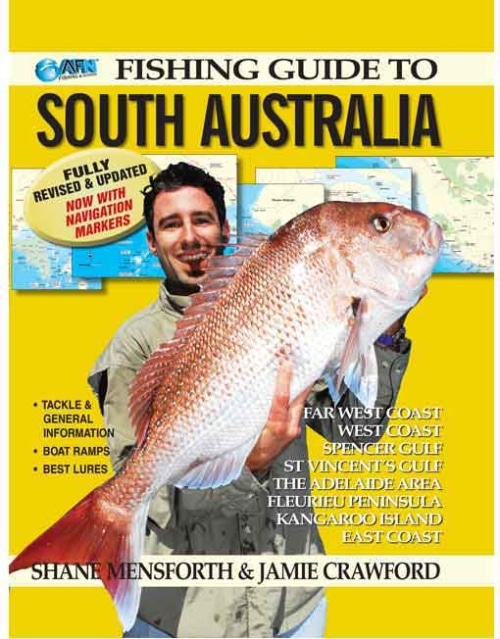 In the Fishing Guide to South Australia, Shane Mensforth and Jamie Crawford cover their home state's entire coastline, from the Victorian border all the way across to Western Australia. The Fishing Guide to South Australia will appeal to locals and visitors, experienced anglers and those new to the sport. In fact, anyone who enjoys wetting a line in SA will find it an essential reference.
 -
 GPS Handbook Fishing Marks Australia Wide is an invaluable companion to all anglers. It is the complete guide on how to use and get the best from your GPS, then it tells you where to fish around Australia. Almost every angler who fishes on the water around Australia either uses a GPS or wishes they did! However, many users find mastering their GPS difficult. In the GPS Handbook it clearly explains just how to use and get the best from your GPS. Using these instructions, the GPS enables anglers to determine their latitude and longitude out on the water, as well as helping them to navigate a boat to a particular set of co-ordinates. With this knowledge you can then choose from over 2000 marks listed in the book to either start fishing or find your own secret spot. With a GPS, anglers can now navigate to any co-ordinate without the need for sight reference. Gone are the days when pulling down the church spire meant losing your favourite snapper mark! Pages: 144 pages – Full colour Cover: Flexibound – grain laminated Size: 190mm x 260mm
 -

Fishing Atlas for SE Queensland - New Edition
Our southern Queensland waters envelop the city of Brisbane and the surrounding regions of the Sunshine Coast and Gold Coast. The area provides a wealth of water and fishing opportunities. A feature of this lovely part of the world is that it forms the mixing zone for southern and northern species. How many major Australian cities offer a backdrop that provides top-class fishing for the likes of Spanish mackerel, longtail tuna, snapper, threadfin salmon and bass? There really is much to love about this part of our coastline! -
 New for 2017 - Available in March Fishing Atlas for Port Phillip Bay is a complete guide to fishing the bay and its estuaries, including GPS marks to get you amongst the fish!
 -

 The Landbased Fishing Guide to Brisbane Area features all of the top landbased fishing locations in the region, covering rivers, estuaries, beaches, piers and jetties. Each location has a detailed guide and photos, and there's also sections on knots and rigs, bait presentation and a fish ID guide.
