Prime river fishing spots are often perceived to belong to those that are able to access private property. Nige Webster recently explored parts of the Severn River; he explains that with a little research and a kayak, it’s easy to find solitary fishing grounds.
Photos by Ben Godfrey
Kayak fishing provides the best opportunity to access waters that are often restricted to boaties. A 4WD with yak on top means you are often able to get near enough to the water to drag a yak into the smallest of launch locations. This makes it easy to set about exploring waterways that are seldom done by boat. The Severn River fills Pindari Dam in northern NSW and is typical of smaller river systems that are difficult to access throughout much of the shoreline. This water runs through varied landscape, including farming plains and gorge country; much of the shoreline is located within private property, making it tough for many anglers to access.
Public water is found in places but it too can be difficult to fish due to the nature of bankside terrain; this is where the kayak angler has an advantage. Parks and areas dedicated to the travelling stockman can be used as kayak launch spots. Once on the water, the centre of the river makes a great place to explore various lengths of river and take advantage of the good cod fishing in these parts. I recently filmed a segment for Sport Fish DVD and accessed the system via a Travelling Stock Route. The crew and I took advantage of some great lure fishing for Murray cod. If you think that luring a few Severn cod from a yak is your thing then this one is for you!

Landing casts tight to structure is paramount to catching fish on many occasions.
 The area
Pindari Dam is one of our better impoundment fisheries. It is well-renowned for providing some excellent cod fishing. The Severn River empties into Pindari and also holds a good population of cod. Located to the west of the Great Divide, the local species are dominated by Murray cod and golden perch. This area is best found by heading west of Grafton towards Inverell on Route 38. The river runs through high country areas and access is often satisfied via bush road and undulating terrain: this means 4WD and raised vehicles, although not a necessity, are a good option.
The Severn River above Pindari is characterised by long pools that are separated by sections of rapid. The river can vary from being a relatively wide, ambling system that works through granite boulder country to tight and quite fast running sections of river. Pools can be metres deep in places while some pools consist of only a metre of water throughout, with many scattered boulders protruding from the surface. The banks are often steep and well-vegetated which makes complete shoreline access a tough undertaking. The local cod are a popular target but are usually in the 40 to 70 cm range with 55 cm being the average. Larger fish do exist in the system but are not encountered nearly as often as the competitive smaller fish. Targeting these fish is a pleasure regardless of their size. To catch these special speckled predators is always satisfying when you combine it with the manner in which they strike and battle; to do so in such idyllic surrounds makes it all the more enjoyable. A NSW Fishing Licence will be required if you want to fish here, and be mindful of closed season fishing for cod from September to December.
 High country kayaking
There are many kayaks available in the market these days. Some are better suited to tackling the Severn River cod. Weight, stability and durability are key attributes of a kayak required to take on the rugged environment. Lugging a yak around is par-for-the-course when fishing these parts. This includes dragging the vessel up and down banks and also through sections of slow moving river and rapids. This means you ultimately want a kayak that offers a good combination of light and tough frame.
An important feature of a suitable kayak should be the ability to strap your gear flat within the confines of your chosen hull. Pulling your kayak through shallow water and low, overhanging vegetation is required when moving between sections of the river at times. This is when a hull that can easily be manoeuvred across shallow rocks and running water with gear safely stowed across the deck is very important. The river flows at varying pace but the majority of pools consist of slower moving waters. A yak that is either pedal or paddle powered that provides a stable platform can be used here.
A slow and steady lure presentation is important when catching these higher country cod; however, this is not always made easy when fishing from a yak. The flowing waters of the river mean that as you use your hands to retrieve a lure, the bow of the yak is often turned. This ultimately makes it difficult to continue retrieving a lure at a chosen speed, being that you sometimes end up trying to fish over your shoulder. Bow control becomes an important aspect of successful yak fishing in this scenario and it does help to have a hull that can be controlled by footwork. It is not an essential part of yakking in such waters but life is made easier with a hull that is pedal powered.
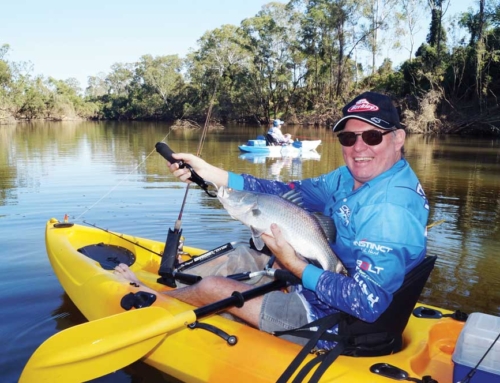
I recently used the Native Watercraft 12.5 Mariner Propel to very effectively fish this system. The hull’s durability, stability and overall weight made it a pleasure to fish from. The hull is comfortable to sit within and also equipped with the stability to enable fishing while standing. The hull looks like it has done some solid work after a weekend in the gorge country but it is reassuring to know the visible scratches are only superficial.
Best times
Severn River natives can be caught throughout much of the year. The warmer months between December and March produce great fishing with the added bonus that fish can be more easily tempted to take lures from the surface. Autumn often promotes increased feeding activity as fish prepare for the winter cool; this means there is often some great fishing during this time. Although warmer waters are associated with the best of the fishing, don’t be fooled into thinking that the fish can’t be caught in winter. Although it gets cold in these parts, some warm winter weather can certainly produce a few active fish in these parts.
The beauty of fishing the Severn is that you don’t have to be up too early to get in amongst the fish. Although the fish will bite during low-light periods of the day, the fishing often improves as the sun gets up and the water warms. An exception occurs if you want to target fish on surface; evening is a popular time to find fish more eager to rise and grab a would-be feed from the top.
The days around and including the full moon phase tend to produce an increase in fish feeding activity. Likewise, fish can often be found to be feeding aggressively during a steady rising barometer; a barometer rise prior to an approaching storm is often associated with some very active fish. However, be careful not to be trapped on slippery wet bush roads following this scenario.

Gorge cod don’t like coming aboard!
Tackle
Baitcast or spin outfits can be used when luring for river cod. Casting heavier lure types such as bibbed hardbody lures and spinnerbaits is effectively satisfied with baitcast outfits. Spin outfits are often used to cast more lightly weighted offerings such as surface lures. The confines of a kayak and the requirement to navigate amongst some thick river vegetation dictate that packing shorter rods makes good sense. Three to 6 kg rods will satisfy casting for and taming Severn predators. Match baitcast and spin reels with 8 to 15 lb braided lines and 12 to 20 lb leaders. Fluorocarbon leader makes for a good option in these parts; abrasive granite boulders can make short work of lighter line classes so the abrasion resistance of fluorocarbon offers some insurance.
Popular native fish lures will all work in the Severn. Local anglers stock tackle boxes with bibbed hardbody lures, spinnerbaits and chatterbaits, paddletail soft plastics and surface poppers or stickbaits. Vibration is the key to a successful strategy in these parts. Any lure that flashes, rattles and wobbles will attract attention from resident predators. Due to the shallow average depth of much of the Severn system, lures do not need to be heavily weighted or required to dive to excessively deep levels. If in doubt regards an effective option to take on your travels, do not look past the spinnerbait. A 1/2 to 3/8 oz Colorado or Willow bladed spinnerbait or chatterbait will hold you in great stead for tangling with local fish.

Darker spinnerbaits are often a favourite in these parts.
The strikezone
The fish in the Severn are often plentiful which makes up for the fact that you will not encounter lots of big fish. Numbers of fish results in competition which means fish will often react aggressively to foreign objects invading their patch of territory. This behaviour dictates that a specific approach will often provide success: the best approach is to ensure lures are put tight into the zones most likely to hold fish and are left in such places for as long as possible during a retrieve.
Casting accuracy is a must. This is why I favour my baitcast outfits; the ability to fire casts and thumb the reel spool as a lure nears structure are paramount to enabling that lure to slide quietly into the water and hard-up against a designated structure. Many strikes are reactive: this means fish will belt a lure as it enters their space which makes it all the more critical to get those casts in the right location. Having put a lure into a prime spot, make sure you retrieve it as slowly as possible past key fish holding points. The longer a lure can be made to stay within the strikezone, the more chance you have of getting a fish to bite. With this in mind, try to select lures that are designed to be retrieved slowly. Spinnerbaits, chatterbaits and wide-bibbed hardbody lures can all be retrieved slowly. Added benefit with these lures is the vibration factor. They all emit lots of vibration and flash and with slow retrieval speed can be left in front of fish for longer periods; this makes them deadly on fish such as cod.
It is sometimes easy to ignore the deeper water when there is so much visible shallow water structure to target. I have had sessions in gorge country where many fish were taken in deeper water. The key to tempting fish here is to keep lures as close as possible to the bottom. For example, if using a spinnerbait, it pays to pause the retrieve every few metres to allow the lure to drop back to bottom before continuing a slow and steady retrieve.
 Summary
High country waters are very scenic places to fish and doing so from the base of a kayak is one of the best ways to enjoy the scenery. Limited access points and shallow water exploring are part of the adventure, which makes the kayak angler well-prepared for experiencing success in these types of waters. With a little research and a sense of adventure you will quickly find that you have the opportunity to be fishing some unique Aussie waters; and I am yet to tire of watching those pretty speckled fish come yak-side!
Nigel Webster is Northern Field editor of Sport Fishing and Field editor for Freshwater Fishing magazines. Based at Noosa he fishes the entire east coast in fresh and salt water – offshore – bream – barra – trout.