Soft plastic lures are not often the first choice of lure when targeting mackerel.
Nige Webster explains the benefits in using a soft lure when chasing these speedsters. The use of a neat rig may have you reconsidering how you chase these sharp-toothed critters when they next hit
your local waters.
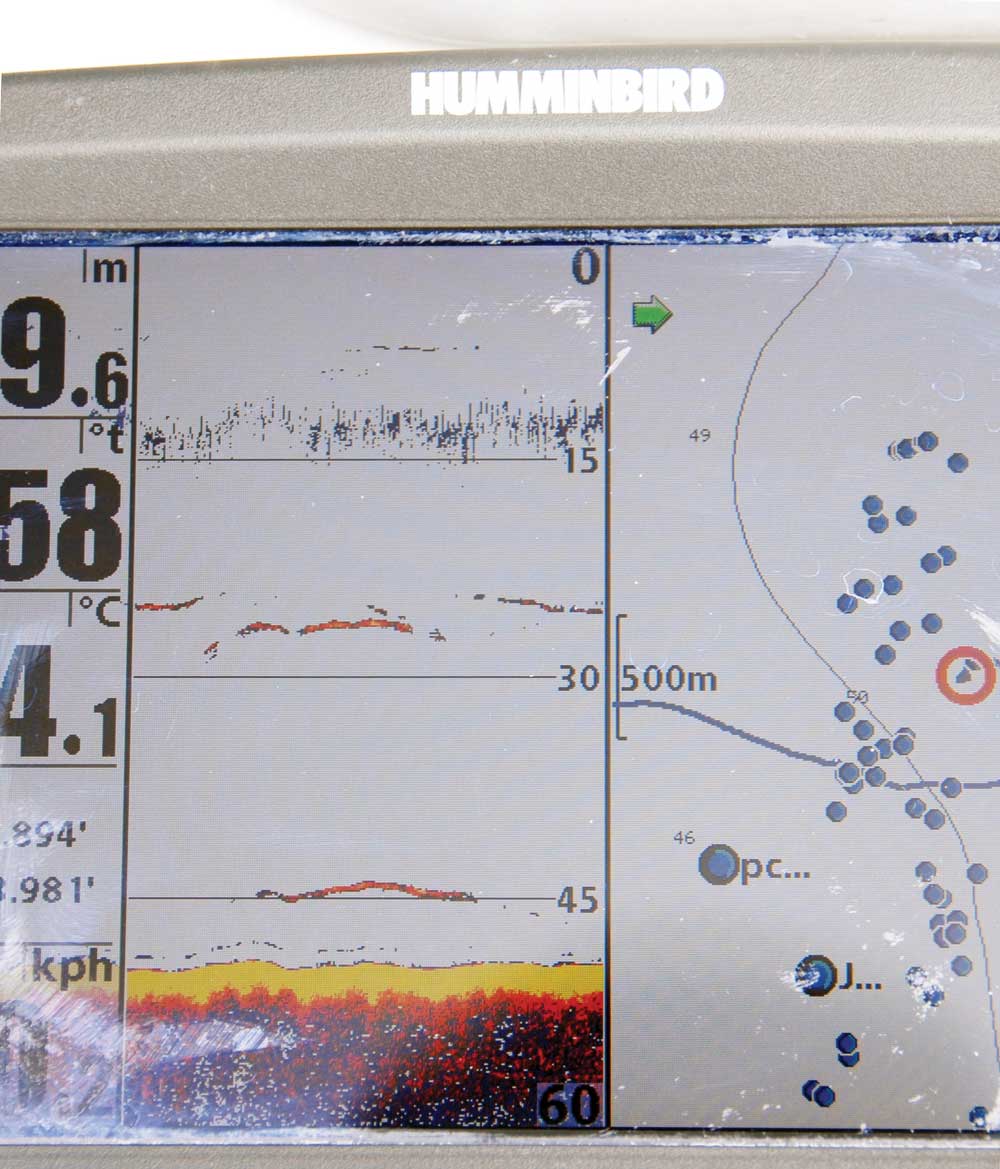
Spanish sounding between 30 and 50 m of water – this is a prime place to rip a soft plastic.
Going Soft
Warmer currents running our coastline in recent years have produced some awesome mackerel fishing. Spotted, Spanish and grey mackerel have been in abundance and in many locations, these fish have shown up early and stayed longer than previous seasons. The extended stay has meant many of us were allowed to a bit of extra time to try different techniques and learn more about how to best target mackerel. My biggest lesson over the past two years has been when the fish were present but proving difficult to catch. Most mackerel fishers will agree that just because fish are there doesn’t mean you will always get them to bite. At various stages of moon and weather I have previously encountered concentrations of mackerel that were very hard to tempt and I couldn’t determine the pattern. It took some persistence and experimentation but I discovered that during these finicky periods I was able to gain some success with the use of subtle presentations. If you want to call it finessing mackerel you would be close to the mark. These subtle presentations included the use of prominent bait-sized soft plastic lures. This posed a few issues because I often lost lures from sharp teeth biting through leader material and when rigged on a standard jighead, mackerel were notorious at quickly slicing soft lures in half: it quickly became an expensive exercise. The fact I was getting interest on plastics when I couldn’t tempt fish on any other type of lure in the box forced me to pursue the soft option. Changing the rig used to target fish with plastics quickly altered my path to success. I often returned with fish when mates of mine using other methods were coming home empty handed. If you want to come along for the soft plastic mackerel ride, then read on.
Location Location Location
To catch mackerel you first have to find them. Following reports of movements of fish up and down the coastline is a good way to predict when to start chasing them. Fishing store reports will give a good idea as to when to get the mackerel gear out. The influences of current movement and structure combine to produce concentrations of baitfish and predators. Fish will often gather in similar locations to that of previous seasons; for a variety of reasons these spots will consistently attract bait.
The start of each day should be used to search a chosen stretch of water for signs of fish. Visible signals of surface bait, jumping mackerel, larger surface splashes and arches showing on the fish finder all indicate you are fishing in the right location.
Plastic Time
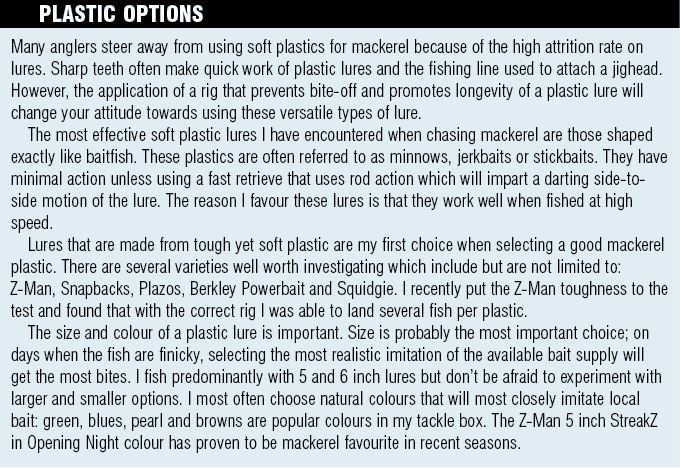
There are many ways to target mackerel and the best method is often dictated by the mood in which they are found. Aggressive fish looking for larger baits are easily tempted by large hardbody lures, metals and live and dead baits. However, there are those tough days that aren’t always easily explained; they often follow periods of good fishing as the moon phase and barometer begin to mature. Regardless of the reason, when I find the fish in a subdued state, experience has shown me that I can still get them to eat a plastic. There may be several reasons for this: I believe it has much to do with the fact that these lures produce less aggressive vibration and flash, and are the best imitation of a lone baitfish. I remember a mate recounting a story of a recent trip whereby school-sized Spanish mackerel were cruising around the boat and although turning to inspect every lure cast at them, refused to eat anything. After questioning him further I discovered that the only lure they hadn’t thrown was a soft plastic.
 A Deadly Soft Rig
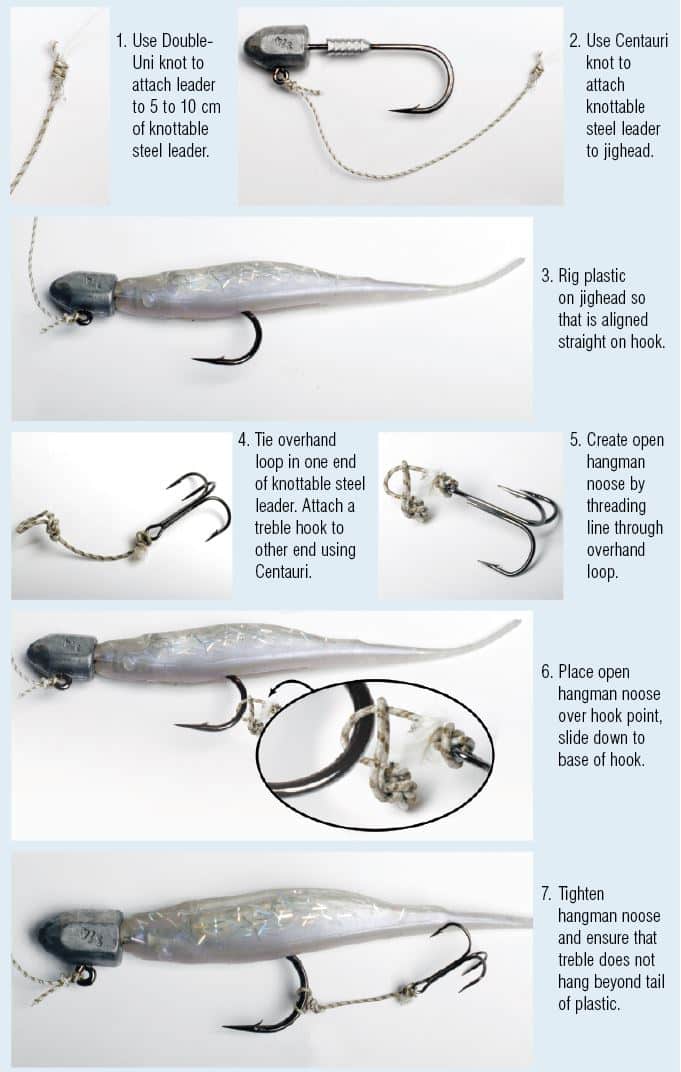
Developing a rig that enables you to cast and retrieve soft plastic lures and prevents sharp teeth chewing through a leader and snipping plastics in half is the key to having heaps of fun with mackerel. After some experimentation I have developed an easy rig that has produced plenty of success. The key ingredients include a jighead, graphite/wire capable of being knotted and a small treble.
 Jighead
Choose a jighead that offers enough gape when rigged in the plastic to ensure quality hook set when a fish chews on your lure. It is very important to select a jighead shaped for speed. This means the head or weight of the jighead should be aerodynamically shaped so that the lure does not roll when retrieved quickly through the water: Nitro and TT HeadlockZ jigheads both perform admirably at speed.
Knotting Wire
A steel leader which can be knotted or line material is the secret weapon when you want to land mackerel on plastics. There are various brands on the market but they must be pliable and easy to work with. The darker the colour of the material the better. I have been using product like Graphite Metal Tresse or Tortue FlexSteel for some time now and cannot fault them. The products aren’t always easy to find but if you can locate them or a similar material in 20 to 40 kg then stock up. Pre-requisites for the line must be that it is flexible and you must be able to tie a Double-Uni knot with it.
Treble Hook
A treble hook completes the rig but the hook must not be so big that it impedes the action of the lure. There are several varieties of fine metal but strong trebles on the market these days. I have had good success with the Mustad Ultrapoint hooks in size 6 and 4 to date.
 Rigging
The first step when connecting the rig is to attach 5 to 10 cm of the steel leader to your fluorocarbon or monofilament leader. Use a Double-Uni knot to do this. I attach the jighead to the leader with a Centauri knot. At the same time you are working with the leader, attach a treble hook to a 3 to 5 cm length of this material. Rig your chosen soft plastic on to the jighead so that the lure lies perfectly straight along the hook. Finally, lay the length of the leader with the treble hook along the tail of the plastic; measure the distance between the gape of the hook and the tail of the plastic and cut the leader to suit. Tie an overhand loop in the loose end of the leader and then forming a hang-man noose within this line, thread the noose over the hook point and tighten it so that it sits flush on top of the plastic lure. The finished product should allow the treble to sit slightly back from the tail of the lure: this means the tail will not repeatedly snag on the treble hook while retrieving. Mates of mine are now also pinning the treble into the latter parts of the tail so that the hook does not snag the tail of the plastic and impede its action. I favour having the treble swing free and the key to this is positioning the hook so that it is ¾ distance between the gape of the hook and the tail of the plastic.
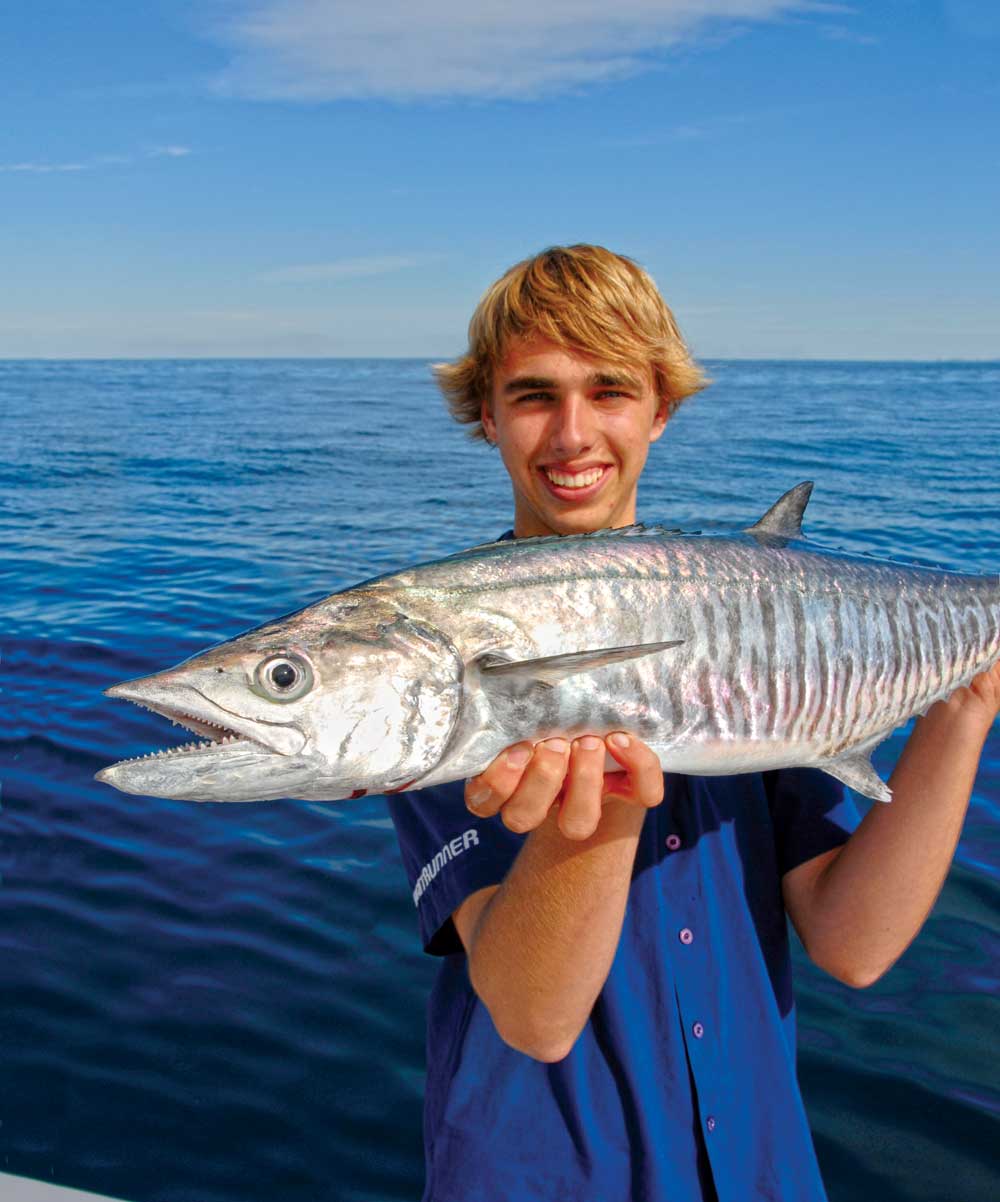
Targeting school sized Spanish mackerel can mean the action is hectic.
Soft Jigging and Spinning
Two scenarios will be found when chasing mackerel. The fish will be actively chasing baitfish near to the surface, or they will be feeding in deeper water. Surface fish are easily found and more easily targeted with a lure. Casting to the edges of surface feeding expressions and retrieving the lure away from the activity will often produce strikes from cruising fish. The advantage in this situation is that an angler can quickly identify the size of the bait being attacked: this makes it easy to imitate bait with a well-suited plastic. Experimenting with time taken to let the lure sink before retrieving is worthwhile. Often large fish will feed a few metres beneath the surface bait. A lure allowed to sink for 5 to 10 seconds before being retrieved often receives plenty of attention.
The most typical scenario and hardest to approach is that of deeply feeding fish. In the event that several boats are working an area, mackerel will often retreat to deeper water to feed. Patrolling the area and carefully watching your fish finder is the way to target these fish. Signs of concentrations of bait and predators on the screen will show you where to place a lure for best results. It is during times where fish are pressured that I have had most success with well-presented soft plastics when chasing mackerel. The key to catching fish is getting the lure to precisely where fish are feeding. This means selecting an appropriately weighted jighead as stated previously. I often target mackerel in 15 to 40 m of water; this usually means I am using jigheads weighted between 5/8th and 1 oz depending on current conditions. The goal is to be able to get a lure to the depth that the fish are holding as quickly as possible without the lure looking too heavy.
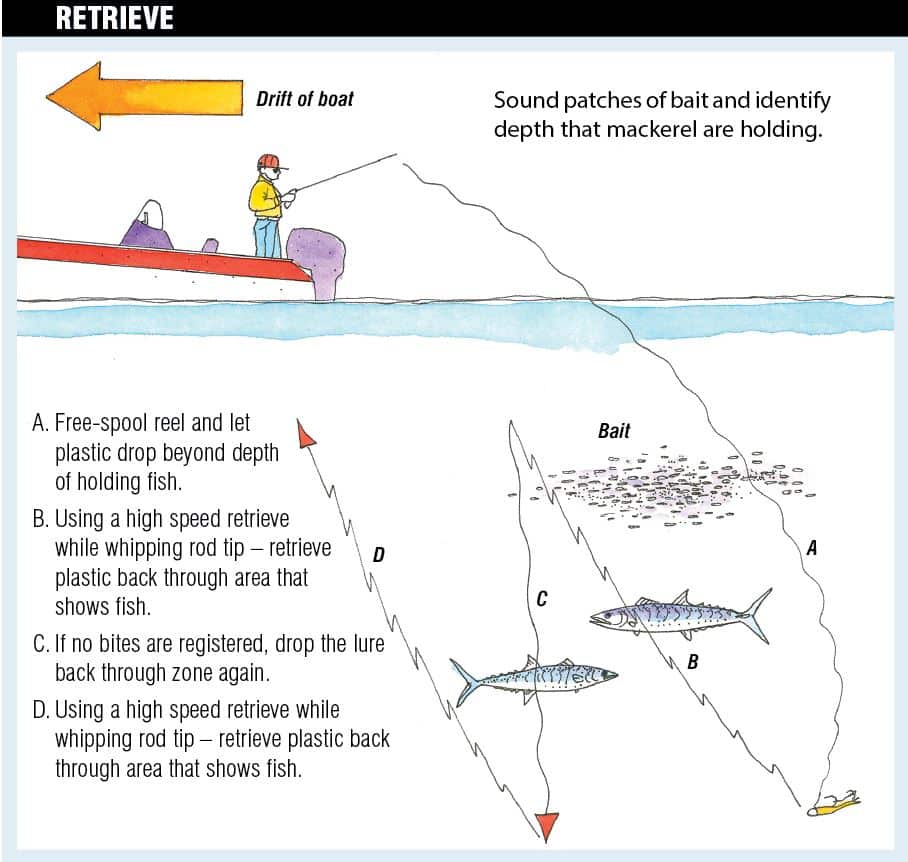
I approach deeply feeding fish much the same way as anglers that troll. I aim to cover as much ground as possible while watching the sounder very closely. It never hurts to have a lure trolled out the back while doing this. In the event that fish are observed on the sounder, I quickly stop the boat and drop a soft plastic overboard; the lure is left to free-fall while watching the line carefully for any sudden increase in line speed as this typically indicates a fish has eaten the lure. Mentally count the lure down and try to estimate the depth it has reached. Once you believe the lure has reached the depth of the where the fish are, retrieve it back through the water. Retrieve speed can be varied until you find a pattern that is producing bites. I often retrieve as fast as possible while jerking the rod tip to promote a side-to-side lure action. Occasionally fish will respond to a more subdued but whipped style of retrieve and the key is to experiment until you have success. Try to keep the lure close to fish holding patterns as much as possible. If you retrieve the lure through the zone you believe to hold fish without any bites being detected, quickly drop the lure back through the fish and repeat the process but maybe with a different retrieve. Occasionally fish may miss seeing your lure so it pays to keep showing it to as many fish as possible.
 Softly Does It
The approach of chasing mackerel on plastics is a very active one; the only thing soft about it is the lure type. It is an exciting way to target these speedsters and can be extremely effective on a given day. The key is to find the fish and then start showing them a lure. Mates of mine that have begun to experiment with this technique are amazed that on some days you may only make 20 casts: the upside is that you are often hooking 5 to 10 fish within those 20 casts. Many of us are only just scratching the surface when it comes to chasing toothy critters on plastics. If you love lure fishing and love your mackerel fishing then this is definitely something you need to have a crack at.
The success and general interest in catching these pelagics on soft lures compelled me to film the subject for an upcoming Sport Fish DVD. If you want to see some of this action, keep an eye out for Sport Fish DVD 12.
Nigel Webster is Northern Field editor of Sport Fishing and Field editor for Freshwater Fishing magazines. Based at Noosa he fishes the entire east coast in fresh and salt water – offshore – bream – barra – trout.